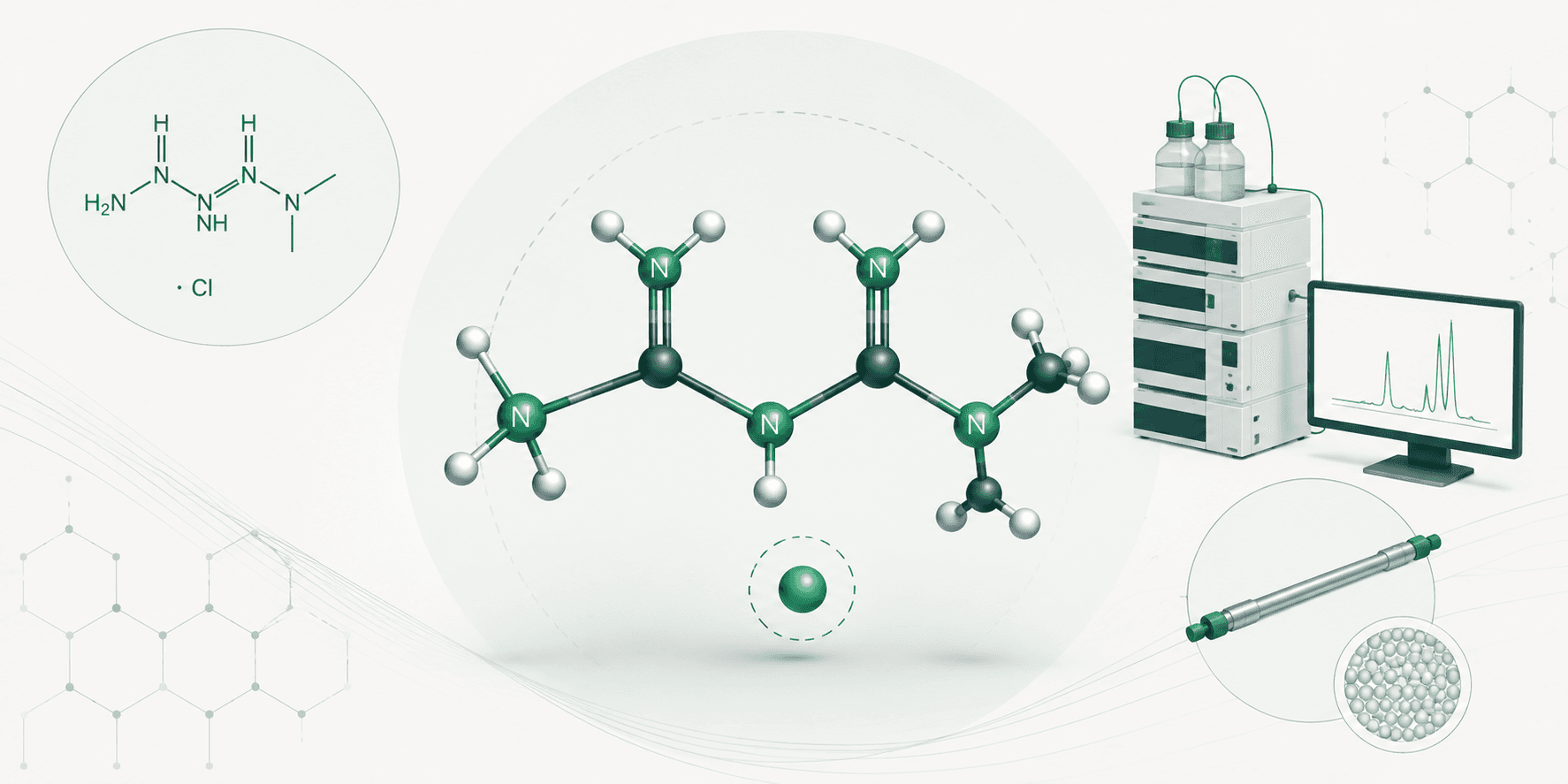
Method Scope and Challenge
This outline describes the general structure of an HPLC assay method for Metformin Hydrochloride, a highly polar, water-soluble, small biguanide molecule that behaves quite differently on standard reverse-phase columns than most small-molecule APIs. Because Metformin has very limited retention under conventional reverse-phase conditions — it elutes very close to the solvent front on an unmodified C18 column — method development for this compound presents a genuinely distinct challenge compared to assay development for a more typical, moderately lipophilic drug substance.
Two broad strategies address this retention challenge: adding an ion-pairing reagent to a conventional reverse-phase mobile phase (which effectively increases the analyte's apparent hydrophobicity by forming a neutral ion pair that partitions more favorably into the stationary phase), or switching to a column chemistry inherently suited to retaining highly polar, ionizable analytes, such as hydrophilic interaction liquid chromatography (HILIC) or a polar-embedded reverse-phase column. Each approach has trade-offs in method robustness, mobile phase complexity, and compatibility with mass spectrometric detection where that is also required, and the choice is generally driven by what other assays the laboratory already runs on the same instrumentation and by long-term method robustness experience within that specific facility.
Chromatographic Conditions
A typical assay method uses either a reverse-phase column with an ion-pairing mobile phase additive, or a polar-embedded/HILIC column with a mobile phase adjusted to a pH where Metformin is predominantly ionized (given its basic biguanide functional groups), with UV detection at a wavelength appropriate to Metformin's chromophore. Method development work generally focuses on achieving adequate retention — since the molecule elutes very early on unmodified reverse-phase columns and adequate separation from the solvent front and any early-eluting excipient peaks is essential — acceptable peak symmetry (biguanides can be prone to peak tailing on some stationary phases due to secondary interactions with residual silanol groups), and clean separation from any process-related impurities or degradation products that could co-elute nearby.
Mobile phase buffer selection and pH control deserve particular care for this analyte: because Metformin's retention (particularly under ion-pairing conditions) is often quite sensitive to small pH shifts near its pKa, a method that is not deliberately buffered and controlled can show meaningful day-to-day retention time drift, which complicates integration and peak identification in a routine QC environment. Method robustness testing (see the related robustness testing article) should specifically challenge pH and ion-pairing reagent concentration for this reason, since these are the parameters most likely to drift or be prepared slightly differently between analysts.
System Suitability
Before sample analysis, system suitability is verified using a standard preparation, typically checking parameters such as: theoretical plate count (a measure of column efficiency, particularly important given Metformin's known tendency toward tailing on some column chemistries), tailing factor (peak symmetry — a criterion that often needs closer attention for this analyte than for a more conventionally-behaved small molecule), and %RSD of replicate standard injections (precision of the system on the day of testing). These checks exist to confirm the chromatographic system is performing consistently enough, on that specific run, for the quantitative result to be trusted — a method can be validated and still fail system suitability on a given day due to column aging, mobile phase degradation, ion-pairing reagent depletion, or instrument drift.
Because ion-pairing HPLC methods in particular can show gradually degrading peak shape as a column ages (ion-pairing reagents can slowly and irreversibly modify some stationary phases), laboratories running this type of Metformin assay routinely often track system suitability trend data over a column's working life, proactively retiring or requalifying columns before performance degrades to the point of an outright system suitability failure mid-batch, which would otherwise force incomplete sample sets to be re-run from the start.
Sample Preparation Considerations
Sample preparation for a Metformin assay is generally straightforward given the compound's high aqueous solubility — dissolution in an aqueous or mobile-phase-compatible diluent is typically sufficient without requiring extraction or other sample cleanup common for less soluble analytes. However, because Metformin Hydrochloride is frequently formulated as a high-dose, high-strength product (immediate-release and extended-release tablets containing many hundreds of milligrams per unit are common), dilution accuracy across a potentially large dilution factor is a meaningful contributor to overall method accuracy, and sample preparation procedures should be written and validated with this in mind rather than assumed to be a trivial step.
For extended-release formulations specifically, sample preparation may also need to address extraction of Metformin from a rate-controlling matrix (see the related matrix vs. reservoir extended-release system comparison article) — confirming complete extraction recovery from the intact matrix before HPLC analysis, since incomplete extraction would produce a systematically low, and therefore misleading, assay result that has nothing to do with the actual potency of the tablet.
Calculation of Results
Assay is calculated by comparing the peak area (or height) of the sample preparation against a reference standard preparation of known purity, run under identical conditions, and expressing the result as a percentage of label claim or of the anhydrous drug substance content, per the applicable monograph's calculation formula. Because Metformin Hydrochloride is typically assayed and labeled as the salt form, care is taken in the calculation to use the correct molecular weight basis (salt versus free base) consistent with how the specification and label claim are actually expressed — a mismatch here introduces a systematic calculation bias that system suitability and precision checks would not catch, since it affects every sample and standard calculation identically and consistently.
Where the method also serves double duty as a related substances method (quantifying process impurities alongside the main assay), calculation logic needs to clearly separate the two purposes — assay calculation against a full-strength reference standard, and impurity calculation typically against either an impurity-specific reference standard or a relative response factor applied to the main peak — since conflating the two calculation bases is a documented, recurring source of calculation error in combined assay/related-substances methods for high-dose, high-solubility drugs like Metformin.
Application to Combination Products
Metformin is very commonly formulated as part of a fixed-dose combination product alongside a second antidiabetic active — a sulfonylurea, a DPP-4 inhibitor, or an SGLT2 inhibitor, among others — which introduces an additional method development challenge: the assay method needs to adequately resolve and quantify Metformin without interference from a co-formulated active that may have very different chromatographic behavior and, potentially, a much higher or lower relative concentration in the same tablet. Because Metformin's own retention behavior already requires the specialized approach discussed above, combination-product method development often involves a more extensive scouting phase than a single-entity Metformin method would, specifically to find conditions where both actives are adequately retained, resolved from each other, and free of mutual interference.
Specificity validation for a combination product method needs to explicitly demonstrate the second active, its own related substances, and common tablet excipients do not co-elute with or otherwise interfere with the Metformin peak, and vice versa — a validation exercise that is meaningfully more involved than single-entity specificity testing, and one that should not be abbreviated simply because each individual active has an established, well-precedented single-entity method available as a starting point.
Extended-Release Formulation Testing
Metformin extended-release formulations are widely used clinically to improve gastrointestinal tolerability and dosing convenience, and they introduce testing considerations beyond the assay method itself — most notably, the dissolution method used to characterize and control the extended-release rate needs its own careful development (see the related dissolution method development article), since the HPLC assay method described here measures total drug content in the finished tablet, not the rate at which that drug is released over time, which is the actual therapeutically relevant control parameter for an extended-release product.
Because Metformin extended-release matrices are often designed around swellable, erodible polymer systems, assay testing on these products requires confirming the extraction procedure used for sample preparation genuinely achieves complete recovery from the intact swollen or partially eroded matrix — a validation exercise distinct from, and in addition to, the standard recovery/accuracy validation performed against spiked placebo matrix during initial method development.
Common Method Robustness Issues
Beyond the pH and ion-pairing sensitivity already noted, Metformin HPLC methods commonly show sensitivity to mobile phase aging (ion-pairing reagents and buffers can degrade or change effective concentration over the several-day working life some laboratories allow a prepared mobile phase), and to injector/needle wash compatibility given the analyte's high water solubility and polarity, which can create carryover risk between injections if wash solvent composition is not adequately optimized during method development. A well-developed method addresses carryover explicitly during validation — verifying a blank injection following a high-concentration standard shows no meaningful residual peak — rather than discovering a carryover problem only after it has already affected a series of routine sample results.
Data Interpretation and Trending
Because Metformin is manufactured and tested at very high volume globally, given its status as a first-line, widely prescribed antidiabetic medication, laboratories running this assay routinely benefit from actively trending both assay results and system suitability parameters over time, not simply evaluating each analytical run in isolation against its pass/fail criteria. A gradual, subtle drift in tailing factor or plate count across successive column lots, for example, is far easier to identify and proactively address through routine trend review than through waiting for an eventual outright system suitability failure that then disrupts an active testing schedule.
This trending discipline is particularly valuable for a method like this one, whose non-standard chromatographic approach (ion-pairing or HILIC conditions) is inherently somewhat more sensitive to gradual reagent, column, and mobile phase aging effects than a more conventional reverse-phase method would typically be — proactive monitoring catches this sensitivity working in the laboratory's favor rather than against it.
Leave your rating