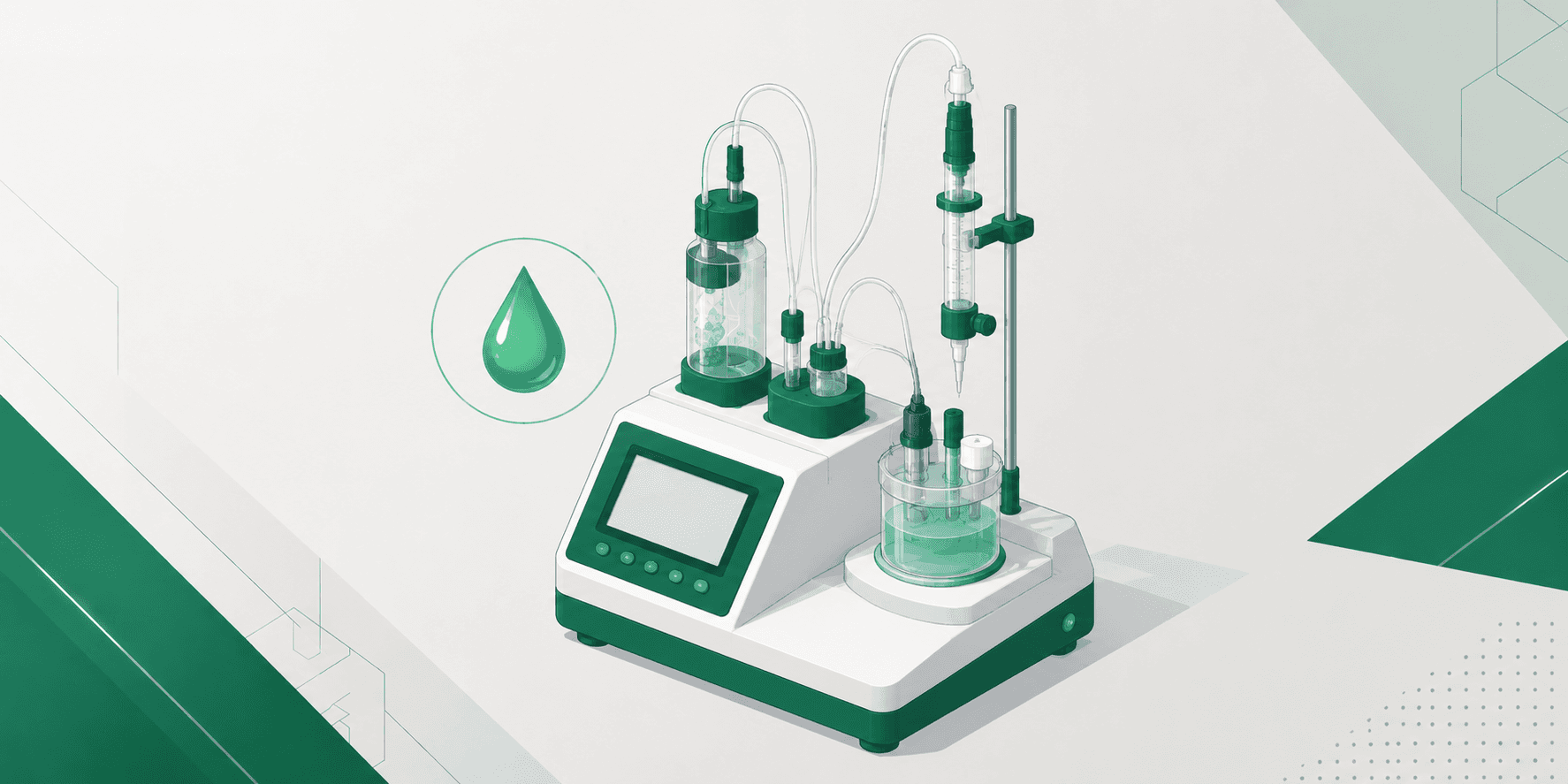
Why This Instrument Warrants Dedicated Attention
Karl Fischer titrators occupy a somewhat unusual position among laboratory instruments: they perform a genuinely quantitative, often specification-critical measurement of water content, directly tied to product specification and, for moisture-sensitive materials, real stability implications, while relying on a chemical reaction and reagent system that is considerably more sensitive to ambient environmental conditions and reagent handling practice than most other routine QC instrumentation.
This combination, genuinely consequential results generated by a method with real, well-documented sensitivity to handling and environmental factors, is why a dedicated calibration and maintenance discipline for this specific instrument class is warranted beyond generic laboratory equipment calibration programs applied uniformly across an entire instrument fleet.
Calibration Frequency
Karl Fischer titrators are typically calibrated, or more precisely for this technique, verified using certified water standards, on a defined schedule combined with meaningful use-based triggers, such as before a critical batch of testing, after any reagent change involving a new lot of titrant or working medium, and following any maintenance work that could plausibly affect the titration cell or electrode performance.
Because Karl Fischer measurements are inherently sensitive to both environmental moisture ingress and reagent condition, a purely calendar-based schedule without these additional use-based triggers can miss meaningful drift that develops between scheduled calibration checkpoints, particularly in laboratories with high sample throughput where reagent consumption and cell exposure occur more frequently than in a lower-volume setting.
Reagent Verification
The titrant's exact water-equivalence factor should be verified regularly against a certified water standard, or for volumetric methods, against pure water of precisely known mass, rather than simply assumed from the reagent's nominally labeled concentration, since titrant strength can drift meaningfully over time due to atmospheric moisture ingress during storage and use, or general reagent aging.
This verification, commonly called standardization, is conceptually and procedurally distinct from broader instrument calibration and needs to be tracked, scheduled, and documented as its own separate activity within the laboratory's overall calibration program. Working medium also degrades over time through cumulative moisture absorption from repeated sample introduction and ambient exposure, and most laboratories establish a defined replacement interval or a monitoring approach to determine when it needs replacement.
Common Sources of Error
The most common sources of unreliable Karl Fischer results are environmental and procedural rather than purely instrumental, including ambient humidity entering the titration cell during sample introduction, especially problematic for hygroscopic or difficult-to-fully-dissolve samples that require an extended open-cell handling time, and drift in the titrant's water-equivalence factor between standardization events.
Sample introduction technique, including speed of introduction, whether a septum reseals cleanly after a syringe injection, and whether the sample itself was adequately protected from ambient humid air before testing, is frequently the actual root cause behind results that superficially appear to be an instrument malfunction rather than a handling issue.
Matrix-Related Interferences
Certain sample matrices present known, chemistry-specific interference risks — some functional groups can undergo side reactions with the Karl Fischer reagent that are not genuinely water-related but nonetheless consume titrant, generating a falsely elevated apparent water content that has nothing to do with the sample's actual moisture level.
Method development for a new material type should specifically screen for this kind of interference rather than assuming it will not occur, particularly for chemically reactive or unusual functional group classes not previously characterized on the specific Karl Fischer method and reagent system already in routine laboratory use.
Maintenance Schedule
Routine maintenance typically includes periodic replacement or reconditioning of the titration cell's working medium solution, electrode cleaning or replacement per manufacturer guidance, since electrode fouling from accumulated sample residue is a common, gradual performance degradation mechanism, and desiccant or molecular sieve replacement in any drying tubes protecting the system's headspace from ambient atmospheric moisture ingress.
A maintenance and calibration log that tracks these consumable-replacement intervals alongside routine calibration and standardization results makes it considerably easier to correlate an emerging result drift with its actual underlying root cause, rather than defaulting to a full, disruptive instrument requalification exercise every time a result appears questionable.
Environmental Considerations for Instrument Placement
Because the technique is inherently sensitive to ambient humidity, physical instrument placement within the laboratory deserves deliberate consideration — locating a Karl Fischer titrator away from doors, air handling vents, or other sources of variable ambient humidity fluctuation reduces the risk of environmentally-driven result variability that would otherwise need to be diagnosed and explained after the fact.
For laboratories in climates or facilities with meaningful ambient humidity variation across seasons, some programs incorporate seasonal awareness into their result trending and investigation practices, recognizing that a genuine seasonal environmental effect on blank or baseline behavior is a real, documented phenomenon distinct from an actual instrument or reagent problem requiring corrective maintenance.
Analyst Technique and Training
Given how sensitive this technique is to handling practice, analyst training deserves particular emphasis relative to many other routine analytical methods — new analysts should be specifically observed and qualified on sample introduction technique, not merely on general instrument operation, since subtle technique differences between analysts can introduce a source of result variability that a generic training sign-off would not adequately address.
Periodic technique refreshers, particularly following any extended period away from routine Karl Fischer testing, help maintain this handling discipline over time, in the same way gowning requalification helps maintain aseptic technique competency in a sterile manufacturing context.
Instrument Qualification Beyond Routine Calibration
Beyond the ongoing calibration and standardization activities described above, a Karl Fischer titrator should undergo formal IQ, OQ, and PQ at initial installation and following any major relocation or component replacement, confirming not just that the instrument can be calibrated successfully on a given day, but that its overall design, installation, and operational performance genuinely meet the laboratory's intended use requirements across the full range of sample types and water content levels the instrument will actually be asked to measure in routine practice. This formal qualification, distinct from day-to-day calibration and standardization, establishes the equipment's baseline validated state that ongoing routine activities are then measured against.
Where a laboratory operates both volumetric and coulometric Karl Fischer instruments, qualification and method assignment should clearly document which instrument type is used for which material or concentration range, and the rationale for that assignment, so that an analyst selecting an instrument for a new or unfamiliar material has clear, documented guidance rather than relying on informal, undocumented laboratory convention that may not be consistently understood or applied across different analysts and shifts.
Comparability Between Multiple Titrators
Laboratories operating more than one Karl Fischer titrator, whether for throughput or redundancy reasons, should periodically confirm comparability between units using a common certified water standard, since subtle differences in cell geometry, electrode condition, or reagent handling between units can produce a small but real bias that would not be apparent from either unit's own independent calibration record considered alone, particularly in a laboratory where different analysts habitually favor different units for reasons unrelated to any documented technical justification, meaning a systematic inter-unit bias could persist undetected for an extended period simply because no single analyst's own routine work would ever directly expose the discrepancy between what the two instruments would report for the identical sample. Establishing a periodic, scheduled cross-comparison, rather than relying on this kind of coincidental discovery, is a straightforward and inexpensive practice that gives a laboratory genuine, proactive confidence that its full titrator fleet remains mutually consistent, rather than each unit merely being independently within its own individually acceptable calibration tolerance.
Investigating Karl Fischer-Related Out-of-Specification Results
Given the documented sensitivity of this technique to handling, environment, and reagent condition, an out-of-specification water content result should prompt an investigation that specifically considers these method-related factors before concluding the material itself is genuinely non-conforming, checking recent standardization data, reviewing whether any recent maintenance or reagent change coincides with the questionable result, and confirming the specific analyst's technique was consistent with validated procedure. This is not a recommendation to routinely dismiss unfavorable results as method artifacts, but a recognition that this particular technique carries genuine, well-documented sources of method-related variability that a rigorous, scientifically sound investigation needs to specifically evaluate and rule out before reaching a conclusion about the material's actual quality.
Leave your rating