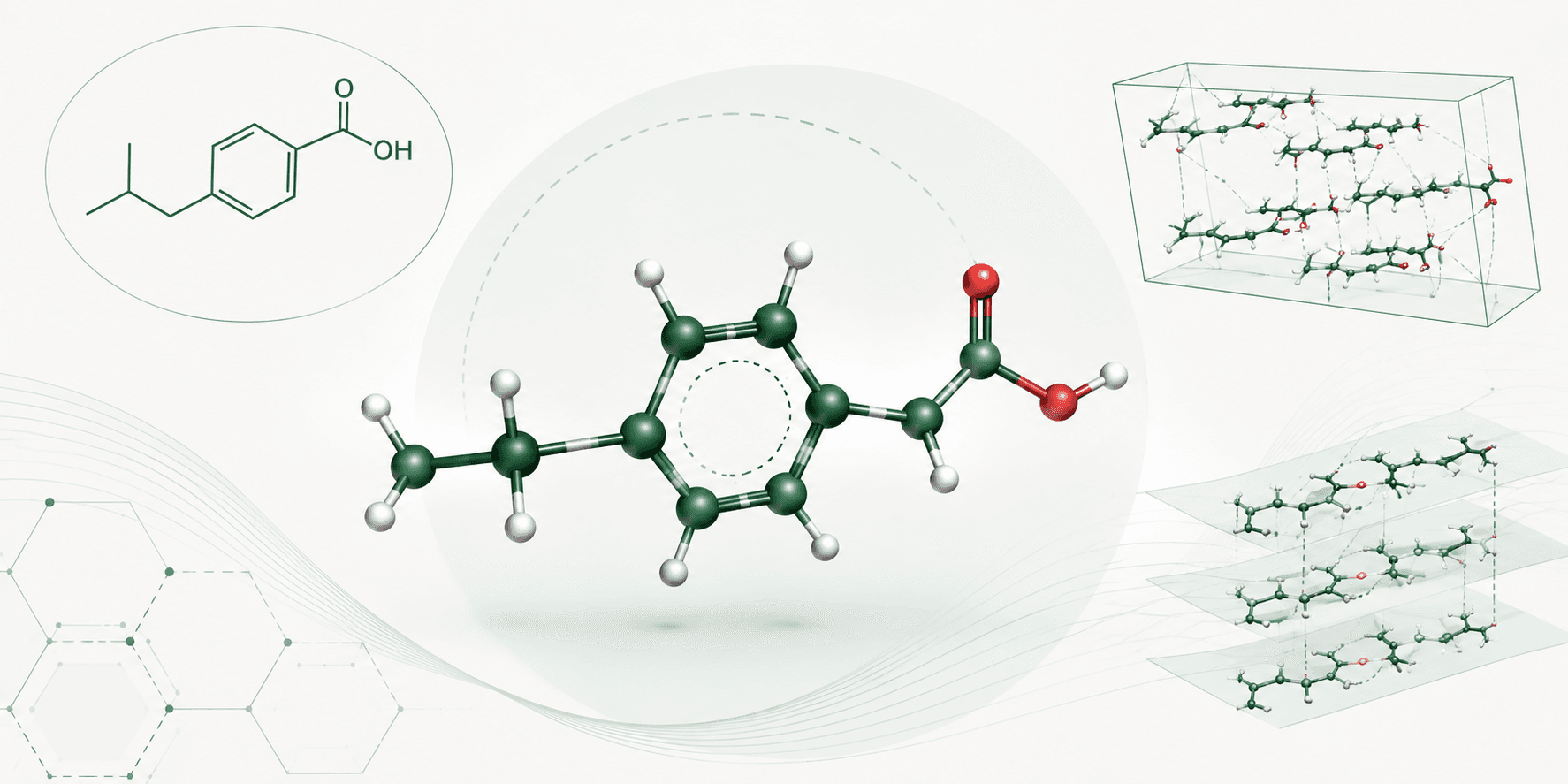
Why Polymorphism Matters
Polymorphism is the ability of a solid substance to exist in more than one crystal lattice arrangement while retaining exactly the same chemical composition — the molecules are identical, but how they pack together in three-dimensional space differs between forms. For a formulator, this matters because different polymorphs of the same API can have materially different solubility, dissolution rate, melting point, mechanical (compaction) behavior, and physical stability, even though a standard identity test based on chemical structure alone would not distinguish between them. Two lots of "the same" API, both correctly identified by IR spectroscopy or mass spectrometry, can behave quite differently on a tablet press or in a dissolution bath if their underlying crystal form differs.
Ibuprofen is a well-studied example in the pharmaceutical solid-state literature precisely because its crystallization and solid-state behavior have real, documented downstream effects on processing — its needle-like crystal habit in particular has long been recognized as a practical challenge for powder flow and tableting, independent of any polymorphism question. The practical risk formulators need to manage is that a change in crystal form or habit — whether introduced deliberately by a supplier's process change, or unintentionally during milling, granulation, or storage — can shift a formulation's dissolution profile, flow behavior, or compaction behavior without any corresponding change to the material's chemical purity specification, meaning a routine assay and related-substances test would not flag the change at all.
Common Crystal Forms and Habit
Ibuprofen is most commonly supplied and used in its stable crystalline form, which is well characterized in the pharmaceutical literature and pharmacopoeial monographs and is the form virtually all commercial formulations are built around. Metastable forms and the amorphous state have been studied academically for their solubility advantages — since disrupting the stable lattice generally increases apparent solubility — but they carry a meaningful physical-stability risk: metastable forms tend to convert toward the more thermodynamically stable form over time, particularly under humidity or thermal stress, which can undermine a formulation's shelf-life claims if not properly controlled and monitored.
Separate from polymorphism strictly defined, Ibuprofen's characteristic needle-like crystal habit (the external shape crystals grow into, which can vary even within a single polymorphic form depending on crystallization conditions) is itself a well-recognized processing challenge — needle-shaped crystals tend to interlock and resist free flow, complicating both powder handling and achieving consistent die fill during tableting. Because crystal habit, like crystal form itself, is influenced by the crystallization conditions used during API manufacture (solvent system, cooling rate, agitation, and seeding practice), a change of API supplier — even one supplying material that passes the same chemical specification — carries some risk of a subtle habit or form shift that a standard identity/assay test would not detect.
Impact on Formulation and Manufacturing
Crystal form and particle habit influence several formulation-critical properties simultaneously: intrinsic dissolution rate (and therefore, in some cases, bioavailability), powder flow and compressibility during tableting, and the physical stability of the drug substance itself within the finished product over its shelf life. For a borderline-soluble compound like Ibuprofen, a change in crystal form can be the difference between a formulation that reliably passes dissolution testing and one that does not — which is exactly why dissolution methods for such products are often deliberately designed to be discriminating (sensitive) to this kind of solid-state variability, rather than optimized purely for a fast, complete release profile.
On the manufacturing side, needle-like or otherwise poorly flowing crystal habits commonly drive formulation and process choices that would not be needed for a more isometric, free-flowing crystal form — wet granulation is frequently favored over direct compression specifically to overcome poor native flow, and glidants are used more aggressively to compensate. A formulation validated around one supplier's specific crystal habit characteristics may not perform identically if a second, chemically-identical-on-paper supplier's material has a meaningfully different habit, which is a common and under-appreciated source of technology transfer difficulty when qualifying a backup API source.
Analytical Characterization Techniques
Confirming and monitoring crystal form typically relies on a combination of complementary techniques, since no single method is definitive on its own. X-ray powder diffraction (XRPD) is generally considered the most direct and reliable method, producing a diffraction pattern that reflects the specific, repeating lattice arrangement of a given polymorph — different polymorphs produce visibly different diffraction patterns, making XRPD well suited to both form confirmation and, with appropriate calibration, quantifying the proportion of a minor polymorphic form present in a mixture.
Differential scanning calorimetry (DSC) complements XRPD by characterizing thermal behavior — melting point, and any solid-state transitions occurring on heating — which can reveal a polymorphic difference through a shifted or additional thermal event, though DSC alone is generally less definitive than XRPD for unambiguous form identification since thermal events can sometimes be interpreted multiple ways. Infrared or Raman spectroscopy can also be sensitive to certain polymorphic differences, particularly where the different lattice packings meaningfully affect specific vibrational modes, and are sometimes favored for routine, faster screening once a form difference has already been characterized by XRPD and DSC during development.
Control Strategy
A practical control strategy typically includes: characterizing the intended crystal form during development using the techniques above, specifying that form (or an equivalent-performance requirement tied to the properties the formulation actually depends on) in the incoming API specification, and monitoring for form changes as part of ongoing stability and change-control programs whenever the API supplier, synthesis route, or micronization/milling process changes. The goal is not to over-specify a form the formulation does not actually depend on for its performance, but to know clearly which physical properties the formulation is sensitive to and to control those deliberately, rather than assuming chemical identity testing alone provides adequate assurance.
Where a formulation has demonstrated genuine sensitivity to crystal form or habit — evidenced, for instance, by a dissolution or flow difference observed between development batches — it is generally worth building a routine XRPD or equivalent check into incoming material release testing for that specific product, rather than relying solely on periodic supplier audits or infrequent verification. This additional testing burden should be weighed against the demonstrated risk; for formulations shown to be relatively insensitive to reasonable crystal-form variation, routine polymorph testing on every incoming lot is unlikely to be a proportionate use of laboratory resources.
Regulatory and Supplier Qualification Considerations
Regulatory filings for products built on a polymorph-sensitive API generally need to specify the intended crystal form explicitly and demonstrate the manufacturing process reliably delivers it, since a regulator reviewing a bioequivalence or stability submission needs assurance that the tested clinical or stability batches are representative of what will actually be commercially manufactured going forward. A change in crystal form after approval — even one arising from an ostensibly unrelated supplier or process change — can constitute a significant post-approval change requiring its own supporting data package.
For supplier qualification specifically, this means the qualification package for a new Ibuprofen API source should go beyond confirming the material meets the chemical specification, and should include confirmation that the crystal form (and, where relevant, characteristic particle habit) is consistent with what the formulation was originally developed and validated around. Skipping this step is a common, avoidable root cause of an otherwise unexplained dissolution or manufacturability problem surfacing only after a new supplier has already been qualified and put into routine production use.
Investigating an Unexplained Manufacturing Deviation
When a formerly stable manufacturing process for an Ibuprofen-containing product begins showing an unexplained shift — worsening flow, inconsistent tablet weight, or a dissolution trend drifting toward its specification limit without any documented process or formulation change — crystal form or habit variation should be an early, not a last-resort, line of investigation, precisely because it is invisible to routine chemical release testing. A targeted XRPD comparison between the currently in-use API lot and a retained sample from a period when the process was known to be well-behaved is often one of the fastest ways to either rule in or rule out a solid-state explanation before pursuing more time-consuming investigative paths.
This is particularly worth emphasizing because a solid-state root cause is easy to overlook in a standard deviation investigation framework built primarily around chemical assay, related substances, and standard in-process parameters — none of which would flag a crystal form shift on their own. Facilities that have experienced this failure mode once often build a routine incoming XRPD check into their Ibuprofen API release testing going forward, specifically as a lesson learned from an investigation that took longer than necessary because solid-state characterization was not considered until other, more conventional explanations had already been exhausted.
Interaction with Formulation Excipients
Crystal form stability is not evaluated in isolation from the rest of the formulation — certain excipients, particularly those capable of hydrogen bonding or forming eutectic mixtures with the API, can influence whether a metastable form persists or converts during processing and storage. Excipient compatibility studies (see the related article on this topic) conducted using only the intended stable crystalline form may not adequately reveal a compatibility issue that would only manifest if a metastable form were inadvertently introduced, which is one reason solid-state characterization and excipient compatibility work are often planned together rather than as fully separate development streams during early formulation development.
Processing steps that involve heat or mechanical energy — granulation drying, milling, or compression itself — can in principle provide the activation energy needed to trigger a form conversion that would not occur under passive storage conditions alone, which is why solid-state stability assessment ideally includes samples taken after key manufacturing steps, not only the starting raw material and the final finished product, to confirm the intended form survives the full manufacturing process intact.
Leave your rating