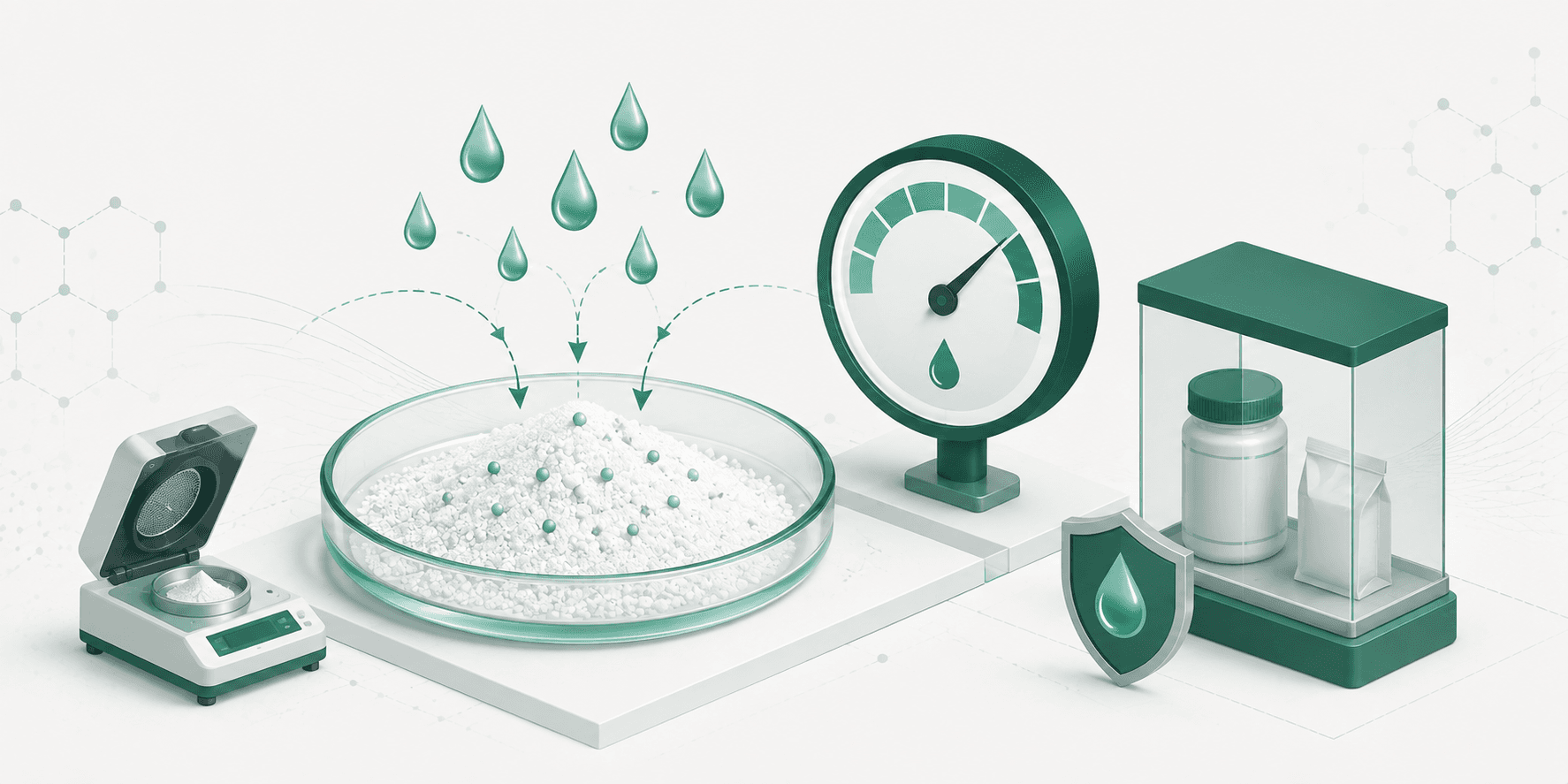
What Hygroscopicity Means and Why It Is Assessed
Hygroscopicity describes a material's tendency to absorb moisture from the surrounding environment, and it is one of the most practically consequential physical properties assessed early in a new drug substance's characterization, because it directly informs downstream decisions about packaging, storage conditions, manufacturing environmental controls, and, in some cases, whether the substance's crystal form itself needs to be re-evaluated (since some polymorphs of the same compound can have meaningfully different hygroscopic behavior — see the related polymorphism article). A material's hygroscopicity is a fundamental, largely fixed physical characteristic for a given solid-state form, not something that can be substantially altered through formulation alone, which is why it needs to be characterized and planned around rather than assumed away.
Hygroscopicity Classes
Pharmaceutical materials are commonly grouped into descriptive classes — non-hygroscopic, slightly hygroscopic, moderately hygroscopic, and very hygroscopic (or deliquescent, for materials that can absorb enough atmospheric water to actually dissolve themselves into a liquid or semi-liquid state) — based on the mass of moisture gained under defined relative humidity storage conditions over a defined period. This classification is a practical, widely used shorthand for guiding packaging and handling decisions, and while some pharmacopeial general chapters provide illustrative classification schemes, the classification itself is generally used as a working risk category rather than a strict, universally standardized pharmacopoeial pass/fail requirement applied identically to every material.
Test Procedure
A typical hygroscopicity assessment exposes a weighed sample to one or more fixed relative humidity conditions — commonly generated using saturated salt solutions in a closed container (each specific salt reliably generates a specific, well-characterized equilibrium relative humidity) or a controlled environmental humidity chamber — for a defined exposure period, then measures the resulting mass gain gravimetrically against the sample's initial dry weight. Testing across a meaningful range of relative humidity conditions, rather than relying on a single fixed condition, gives a considerably more complete and more useful picture of how moisture uptake behavior actually changes as humidity increases, which is generally more informative for setting realistic, risk-appropriate storage and handling conditions than a single pass/fail data point at one arbitrary humidity level.
Because moisture uptake kinetics can vary meaningfully between materials — some reach an apparent equilibrium moisture content relatively quickly, while others continue slowly gaining (or, for genuinely deliquescent materials, accelerating) mass over an extended period — testing protocols often include multiple mass measurement time points throughout the exposure period, rather than only a single measurement at the end, so the kinetic behavior itself, not just a single equilibrium-like endpoint value, is properly characterized and understood.
Storage Implications
A material's hygroscopicity classification directly informs how much environmental control is genuinely warranted during storage and handling operations. A material found to be moderately or highly hygroscopic may need dedicated, actively humidity-controlled storage areas, deliberately limited exposure time during dispensing and weighing operations (to minimize cumulative exposure during the periods the container must necessarily be open), and tighter, more frequent environmental monitoring of the storage and handling areas — none of which would typically be justified, and would simply add unnecessary operational cost and complexity, for a genuinely non-hygroscopic material where such controls provide no corresponding quality benefit.
This classification-driven, risk-proportionate approach is important both for cost efficiency and for genuine quality assurance: over-specifying environmental controls for a material that does not actually need them dilutes organizational attention and resources away from materials that genuinely do carry meaningful hygroscopic risk, while under-specifying controls for a genuinely hygroscopic material creates real quality risk that may not become apparent until a downstream stability or manufacturing problem surfaces, well after the initial handling decisions were made.
Packaging Selection
Hygroscopicity classification also directly drives primary packaging material selection — moisture-sensitive materials are considerably more likely to require moisture-barrier packaging, such as heat-sealed aluminum foil pouches or rigid containers incorporating an appropriate desiccant, while materials with low hygroscopic sensitivity can often be adequately protected using simpler, less expensive packaging without meaningful additional moisture-ingress risk. This same classification-to-packaging logic extends downstream to the finished drug product's own primary packaging decisions, which is why hygroscopicity data generated on the raw drug substance is typically an early, foundational input into a formulation's overall packaging strategy discussion (see the related blister material selection article for how this plays out at the finished-product level).
Connecting Back to Finished-Product Stability
It is important to recognize that raw material hygroscopicity classification, however carefully performed, is an input to — not a substitute for — real, finished-product stability data generated in the actual intended packaging configuration. A formulation's own moisture sensitivity can differ from the raw drug substance's inherent hygroscopicity, since excipients, processing (such as wet granulation, which introduces and then removes moisture as part of normal manufacturing), and the specific packaging configuration all interact to determine the finished product's real-world moisture behavior. Hygroscopicity testing on the raw material should therefore be treated as an early risk-flagging and packaging-planning tool, with the actual packaging decision ultimately confirmed through real accelerated and long-term stability data in the finished, packaged product rather than relied upon as a standalone substitute for that confirmatory stability work.
Handling Ambiguous or Borderline Classification Results
A material whose measured moisture uptake sits near the boundary between two hygroscopicity classes presents a genuine practical decision point: applying the more conservative (higher-control) classification is generally the lower-risk default, but this needs to be weighed against the real operational cost of unnecessarily stringent handling requirements applied over the material's entire commercial life. Rather than resolving this ambiguity purely by classification convention, it is often more informative to directly link the borderline material to the specific downstream risk it poses — for example, confirming through actual accelerated stability data whether the moisture uptake level observed at the boundary condition is sufficient to cause a meaningful, measurable degradation effect in the finished product, rather than relying on the classification label alone to drive the final handling decision.
This data-driven resolution is particularly worthwhile for a material used at large commercial volume, where the cumulative operational cost of unnecessarily stringent humidity-controlled handling — specialized storage space, limited dispensing windows, additional environmental monitoring — can be substantial over the life of a commercial product, making the upfront investment in confirmatory stability data a reasonable one relative to the ongoing operational cost avoided.
Environmental Control During Manufacturing Operations
Beyond storage, hygroscopicity classification should also inform manufacturing environment controls during active processing — dispensing, blending, and other operations where a hygroscopic material is necessarily exposed to ambient room conditions for some period. Manufacturing areas handling genuinely hygroscopic materials may warrant dedicated humidity control (distinct from, and in addition to, any particulate cleanroom classification requirements the area may separately need to meet), and process design should minimize the cumulative open-exposure time a hygroscopic material experiences during a given manufacturing operation, since this exposure window — not just the material's total time in storage — is often where the most concentrated moisture uptake risk actually occurs in practice.
Hygroscopicity in the Context of Formulation Excipient Selection
Hygroscopicity assessment is not limited to the active ingredient alone — excipients also vary considerably in their own moisture affinity, and a formulation combining a moisture-sensitive API with a highly hygroscopic excipient can create a compounded moisture management challenge greater than either component's individual behavior would suggest, since a hygroscopic excipient can effectively act as a local moisture reservoir within the finished dosage form, potentially exposing an adjacent moisture-sensitive API to more localized humidity than the product's overall packaging and storage conditions alone would predict. Excipient compatibility studies conducted under humidity stress (see the related excipient compatibility study design article) are one of the practical mechanisms through which this kind of compounded moisture risk is typically identified during formulation development, rather than assumed away based on each individual ingredient's separately assessed hygroscopicity classification.
Where a genuinely hygroscopic excipient is functionally necessary to the formulation and cannot reasonably be substituted, formulation-level mitigation strategies — such as physical separation of the hygroscopic excipient from the moisture-sensitive API within a multi-layer or coated dosage form, or increased reliance on packaging-level moisture protection to compensate — become part of the overall risk management approach, developed and confirmed through the same real, finished-product stability data discussed above rather than through raw-material-level hygroscopicity data alone.
Comparing Hygroscopicity Methodology Across Suppliers
When comparing hygroscopicity data supplied by different API vendors, or generated in-house against a vendor's own reported classification, it is worth confirming the underlying test methodology is genuinely comparable before treating the classifications as directly interchangeable — differences in exposure duration, the specific relative humidity condition tested, and even the specific method used to generate that humidity (saturated salt solution versus mechanical humidity chamber) can all produce a somewhat different apparent classification for the same underlying material. A supplier's hygroscopicity classification quoted without the underlying test conditions clearly stated should generally be treated as a starting reference point rather than a directly comparable, drop-in equivalent to an in-house classification generated under a specifically defined internal method.
For a material central to a company's own product portfolio, generating in-house hygroscopicity data under a clearly defined, internally validated method — rather than relying solely on supplier-provided classification data of uncertain or unstated methodology — provides a more reliable, consistent basis for the packaging and storage decisions that classification ultimately informs, particularly where multiple qualified suppliers are compared against each other using what should be a common, internally consistent testing basis.
Leave your rating