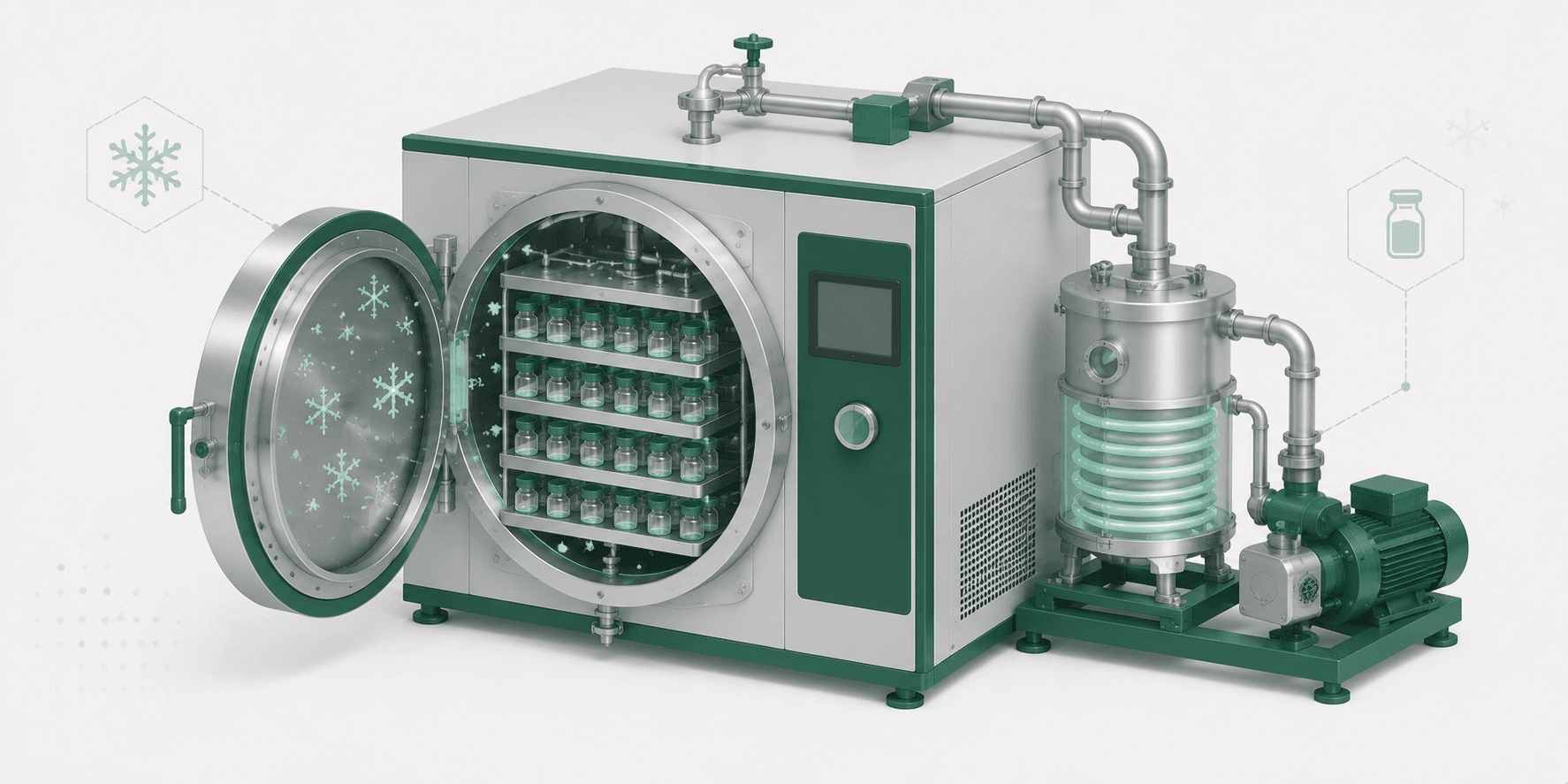
The Interdependence of Equipment and Process for Lyophilization
Freeze-drying equipment presents a somewhat distinctive qualification challenge compared with many other pharmaceutical processing equipment types: the equipment's own inherent performance characteristics, most importantly shelf temperature uniformity and condenser capacity, directly and materially constrain what product-specific cycles can actually be developed and reliably executed on that specific equipment.
This means equipment qualification and product cycle development are more tightly interdependent for lyophilization than for many other unit operations, where equipment capability and process parameter selection can more often be treated as largely separable concerns addressed independently of each other.
Key Process Parameters
A freeze dryer's core controllable parameters are shelf temperature, chamber pressure, and, during the critical primary drying phase generally the longest and most process-sensitive phase of a lyophilization cycle, the rate at which these parameters are ramped and subsequently held at target.
Equipment qualification needs to demonstrate the dryer can genuinely achieve, precisely control, and reliably hold these parameters across the full operating range the facility's current and reasonably anticipated future products require, since different formulations frequently call for meaningfully different shelf temperatures and vacuum levels depending on their specific eutectic or collapse temperature characteristics.
Equipment Qualification Scope
Equipment qualification for a freeze dryer typically verifies shelf temperature uniformity both across each individual shelf's surface and between different shelves within the chamber, since uneven shelf temperature directly and predictably translates into inconsistent product quality across a single batch, and condenser capacity and performance, its genuine, demonstrated ability to actually remove the sublimed water vapor at the rates the intended production-scale process demands.
An undersized or underperforming condenser can allow chamber pressure to rise uncontrolled during aggressive primary drying, risking product collapse across an entire batch, which is why condenser capacity verification under a genuinely representative worst-case sublimation load is a critical part of thorough equipment qualification, not an assumption taken on faith from the manufacturer's nameplate rating alone.
Cycle Development Link
Product-specific lyophilization cycle development, determining the actual shelf temperature and pressure setpoints and the specific ramp and hold times appropriate for a given formulation, depends fundamentally on the equipment first being qualified to reliably deliver whatever setpoints the intended cycle actually calls for.
A cycle successfully developed and validated on one specific freeze dryer cannot simply be assumed to transfer directly and reliably to a different unit, even a nominally similar model from the same manufacturer, without first confirming the two units have genuinely comparable shelf temperature uniformity and thermal transfer characteristics, a well-recognized source of technology transfer difficulty specific to lyophilized products.
Thermal Mapping and Shelf Characterization
A dedicated thermal mapping study, distinct from and typically more extensive than standard equipment IQ/OQ temperature verification, is commonly performed specifically to characterize shelf-to-shelf and within-shelf temperature variation under conditions closely representative of actual production cycles, often using a densely distributed array of calibrated temperature sensors placed directly on multiple shelves simultaneously.
This mapping data becomes a key input into cycle development, informing decisions such as which shelf positions may need to be avoided or specifically monitored for a particularly sensitive, collapse-temperature-critical formulation, and should be repeated whenever a significant equipment modification could plausibly affect the original mapping's continued validity.
Common Issues
Common freeze dryer qualification and operational issues include shelf temperature non-uniformity leading to a measurable difference in product quality between edge-of-shelf and center-of-shelf vial positions within the same nominal batch, and door seal or stopper-seating mechanical issues that compromise the container closure integrity of the finished lyophilized product.
These defect categories may not be apparent through standard visual inspection alone and can require dedicated container closure integrity testing to reliably detect, which is why a mature quality program builds this kind of testing into routine release strategy for lyophilized products rather than relying on visual inspection as the sole detection mechanism.
Ongoing Qualification Maintenance
Because freeze dryer performance characteristics, particularly shelf temperature uniformity and condenser capacity, can genuinely drift over an equipment's operational lifetime through gradual mechanical wear, refrigerant system degradation, or accumulated ice buildup issues if not adequately managed, periodic requalification on a defined schedule, combined with event-driven triggers such as significant maintenance work or a refrigeration system repair, is an important ongoing part of maintaining confidence that previously validated cycles continue to perform as originally characterized.
Vacuum System Integrity and Leak Testing
A freeze dryer's ability to reach and hold the low chamber pressures primary drying requires depends on the overall vacuum system's integrity, including chamber door seals, valve seats, and every pipe fitting and instrument port connected to the vacuum space, and even a small leak that would be inconsequential in many other pieces of process equipment can meaningfully affect drying rate and cycle reproducibility by allowing an uncontrolled ingress of ambient air into the carefully controlled low-pressure environment the cycle depends on.
Routine vacuum leak testing, distinct from the broader equipment qualification activities already described, is therefore commonly incorporated into a facility's preventive maintenance program for freeze-drying equipment, since leak rate can gradually worsen over an equipment's operational life through seal wear and should be proactively monitored and trended rather than only discovered when a cycle unexpectedly fails to reach or hold its target chamber pressure during actual production.
Stoppering Mechanism Qualification
Many lyophilization cycles conclude with in-chamber stoppering, mechanically seating rubber stoppers into vials before the chamber is vented to atmosphere, and this mechanism itself warrants dedicated qualification attention distinct from the shelf temperature and pressure control already discussed, since a stoppering mechanism that seats stoppers inconsistently across different shelf positions or different vial fill patterns can compromise container closure integrity for a subset of a batch in a way that would not be revealed by shelf temperature and pressure data alone.
Qualification of the stoppering function typically includes verification across the full range of vial sizes and shelf loading patterns the equipment is expected to process, with container closure integrity testing performed on samples from multiple shelf positions to confirm the mechanism performs consistently regardless of a vial's specific location within the loaded chamber.
Refrigeration System Reliability and Redundancy Considerations
The refrigeration system driving both shelf cooling and condenser performance represents a genuinely critical piece of supporting infrastructure for any freeze dryer, and facilities running lyophilization as a core, commercially significant manufacturing activity increasingly consider redundancy in this refrigeration infrastructure as part of their overall equipment risk assessment, since a mid-cycle refrigeration failure during a multi-day lyophilization run, some cycles genuinely span several days from loading through the completion of secondary drying, can jeopardize an entire in-process batch of potentially high-value product in a way that few other single-point equipment failures elsewhere in a typical pharmaceutical manufacturing operation would so directly and completely threaten.
Where full refrigeration redundancy is not economically justified for a given facility's scale of operation, a documented contingency plan addressing how an in-process cycle would actually be managed in the event of a partial or complete refrigeration failure, including realistic decision criteria for whether and how to attempt cycle recovery versus accepting batch loss, is a reasonable and increasingly expected risk mitigation measure, and this contingency planning is properly understood as an extension of the equipment's overall qualification and risk management program rather than a purely separate facilities engineering concern disconnected from the pharmaceutical quality system.
Batch Documentation Specific to Lyophilization
Because a lyophilization cycle typically runs continuously over an extended, multi-day period with relatively few discrete operator interventions compared to many other pharmaceutical manufacturing steps, batch documentation for a lyophilized product places particular emphasis on continuous, automated recording of shelf temperature, chamber pressure, and condenser temperature throughout the full cycle duration, since a deviation occurring during an unattended overnight period needs to be reliably captured by the equipment's own data recording system rather than depending on direct operator observation at the specific moment the deviation actually occurred.
Batch record review for a lyophilized product should therefore include systematic review of this continuous process data across the entire cycle duration, not merely confirmation that the cycle completed and produced an acceptable visual result, since a transient excursion occurring at an inconvenient hour that self-corrected before cycle completion could otherwise pass unnoticed by a review focused only on start and end conditions and the finished product's final appearance.
Leave your rating