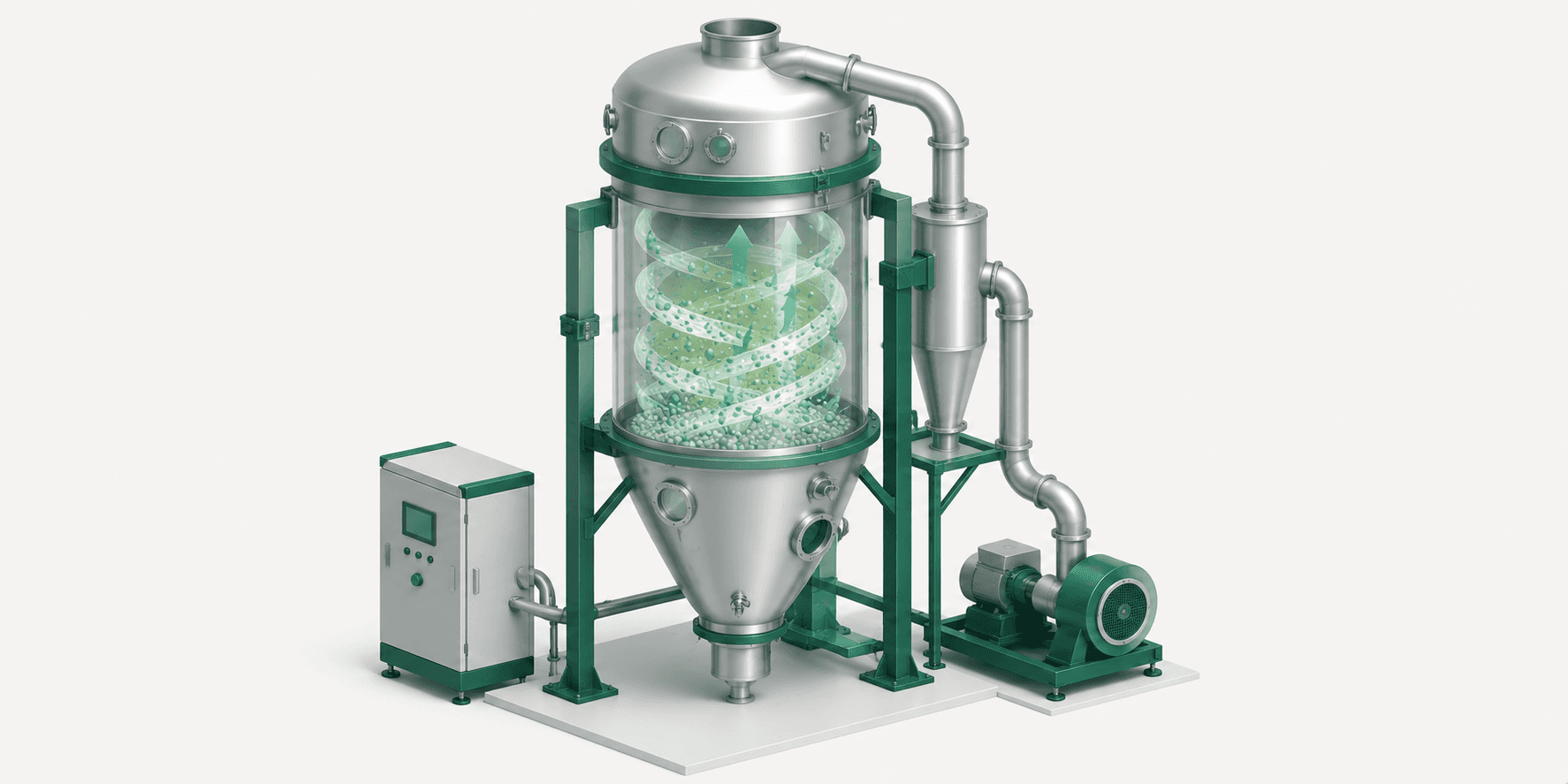
PQ Objectives and Its Place in the Qualification Sequence
Performance Qualification for a fluid bed dryer demonstrates that the equipment consistently and reliably dries product to the required specification, typically moisture or loss-on-drying content, under actual, representative production conditions, using real product batches rather than an empty-chamber or artificially simplified simulated test. Where IQ confirms correct installation and OQ confirms the equipment can achieve its stated operating parameters in principle across its designed range, PQ confirms the equipment genuinely, reliably performs the actual job it exists to do, with real product, under real production conditions.
This distinction matters in practice because equipment can pass IQ and OQ cleanly while still revealing a genuine performance gap only once PQ introduces real product-specific behavior, such as a particular granulation's specific fluidization characteristics, or an unexpectedly uneven drying pattern with a particular batch size, that an empty-chamber or generic OQ test would have no way of revealing on its own.
Critical Process Parameters
Key parameters monitored during PQ typically include inlet air temperature and volume, the primary drivers of drying energy delivered to the product, product temperature during drying, commonly used as a more direct, product-focused indicator of drying progress than inlet air conditions alone, and drying endpoint determination, often monitored via product temperature plateau, the point at which product temperature stops rising further despite continued heat input, generally indicating the bulk of free moisture has been removed.
Establishing which of these parameters is genuinely critical for a given product, and therefore warrants the tightest control and most intensive monitoring during PQ, is typically informed by earlier process development work characterizing how the specific granulation responds to drying conditions, rather than treated as a fixed, universal list applied identically regardless of the specific product's known drying behavior and sensitivity.
Runs and Sampling Plan
PQ typically involves multiple consecutive successful runs, commonly at least three, scientifically justified based on the process's demonstrated variability and complexity, across representative batch sizes and, where relevant, deliberately including worst-case conditions such as the minimum and maximum batch size the equipment is intended to routinely run.
Sampling during each PQ run should be sufficient to characterize both the final endpoint result and any meaningful within-batch variability, for example sampling from multiple locations within the fluid bed chamber to check for uneven drying across the bed, rather than relying solely on a single composite sample that could mask real, spatially-localized under-drying or over-drying within different regions of the same batch.
Establishing and Validating Drying Endpoint Determination
Because the drying endpoint determination method itself, whether product temperature plateau, exhaust dew point, or direct moisture measurement, is what ultimately controls when a real production batch is deemed adequately dried, PQ should specifically confirm that the chosen endpoint indicator reliably and consistently correlates with the actual, directly measured moisture content across the runs tested.
An endpoint indicator that appeared reliable during limited development-scale testing can behave differently at full commercial batch size and loading, where fluidization dynamics and heat transfer characteristics can differ meaningfully from smaller-scale testing. Where a rapid, indirect endpoint indicator is used for routine production decision-making, PQ data correlating that indirect indicator against direct moisture testing across the qualification runs provides the scientific basis for relying on the faster, indirect method going forward.
Handling Batch-to-Batch Granulation Variability
Real production batches, even of the same nominal formulation, can show some batch-to-batch variability in granulation characteristics entering the drying step, such as differences in incoming moisture content from the wet granulation step, or subtle granule size distribution differences carried over from upstream processing.
PQ should ideally capture enough genuine production variability across its qualification runs to demonstrate the drying process and its endpoint determination method remain robust across this normal, expected range of incoming material variability, not solely under an artificially consistent, best-case incoming granulation that would not represent the range of conditions the process will actually encounter over its commercial life.
Acceptance Criteria
Acceptance criteria should tie directly back to the product's actual quality requirements, typically that final moisture content falls within the specification range consistently across all PQ runs and across all sampling locations within each run, and that any monitored critical process parameters remained within the ranges the process was designed and characterized around during earlier development.
A PQ program that passes its runs only because acceptance criteria were set unusually wide, relative to the product's genuine quality requirements, provides limited real assurance of ongoing process capability, so criteria should be derived from genuine process capability and product-quality-driven requirements rather than simply relaxed until the executed runs happen to pass.
Equipment Cleaning Between Products
Where a fluid bed dryer processes multiple different products, PQ planning should also consider how cleaning between products fits into the overall qualification approach — since a dryer's internal surfaces, filters, and airflow paths present a meaningfully different cleaning challenge than simpler equipment types, and PQ scheduling often needs to coordinate with the equipment's separate cleaning validation program rather than treating drying performance and cleaning effectiveness as entirely independent qualification workstreams.
Where cleaning validation for the dryer has not yet been separately completed at the time PQ is executed, the qualification team should confirm this sequencing does not create a gap in the overall equipment readiness picture before the dryer is released for routine multi-product commercial use.
Ongoing Monitoring After PQ
Following successful PQ, ongoing routine monitoring of drying performance, trended over time rather than evaluated only batch by batch in isolation, provides continued assurance the equipment remains in its qualified state. A gradual drift in typical drying time or endpoint indicator behavior, even while individual batches continue to pass specification, can be an early sign of a developing equipment issue, such as gradual filter fouling or airflow distribution changes, worth investigating proactively rather than waiting for an eventual outright batch failure.
Filter Integrity and Airflow Distribution
The fluid bed dryer's filter system, which retains fine particulate while allowing process air to exit, is a critical but sometimes underappreciated element of both drying performance and product containment, and PQ planning should confirm filter condition and integrity are appropriately verified as part of the overall qualification effort, not treated as a purely maintenance-department concern separate from process performance qualification. A degraded or improperly seated filter can affect airflow distribution across the product bed in ways that directly influence drying uniformity, even while the equipment's primary process parameters, such as inlet air temperature, continue to read within their normal expected range.
Where a facility processes potent or highly active materials through the dryer, filter integrity also carries direct occupational safety and cross-contamination significance, and qualification documentation should clearly capture how filter integrity is confirmed both at PQ and on an ongoing routine basis throughout the equipment's operational life, connecting this equipment-level verification to the facility's broader containment and cleaning validation programs.
Scale-Dependent Behavior and Technology Transfer
Fluid bed drying is a unit operation where scale-dependent behavior is particularly pronounced, since fluidization dynamics, heat and mass transfer rates, and the ratio of product surface area to airflow volume all change in non-linear ways as batch size increases from development scale toward commercial scale, meaning a drying process that behaved predictably at smaller scale cannot simply be assumed to scale proportionally without dedicated verification at the intended commercial scale. PQ, executed specifically at commercial scale using commercial-scale equipment, is therefore not merely a formal confirmatory step but a genuinely necessary verification that the process actually works as intended at the scale where it will be used in real, ongoing production, distinct from whatever confidence smaller-scale development work may have already established.
Documenting the Final Qualified Cycle
The final PQ report should clearly document the specific process parameters, drying endpoint criterion, and batch size range the equipment and process were qualified against, giving routine production a clear, unambiguous reference for what constitutes normal, qualified operation versus a deviation warranting investigation. This documentation becomes the baseline for future revalidation decisions whenever a formulation, batch size, or equipment change is proposed, and should be readily retrievable throughout the product's commercial life, since a question raised years later during an investigation or a proposed process change will typically need to refer back to exactly what PQ demonstrated, including the specific acceptance criteria used and how they were derived from the product's actual quality requirements, rather than a vague institutional memory of "the dryer was qualified at some point" that cannot actually answer the specific technical question the later investigation needs resolved.
Leave your rating