From Testing-Based to Risk-Based Control
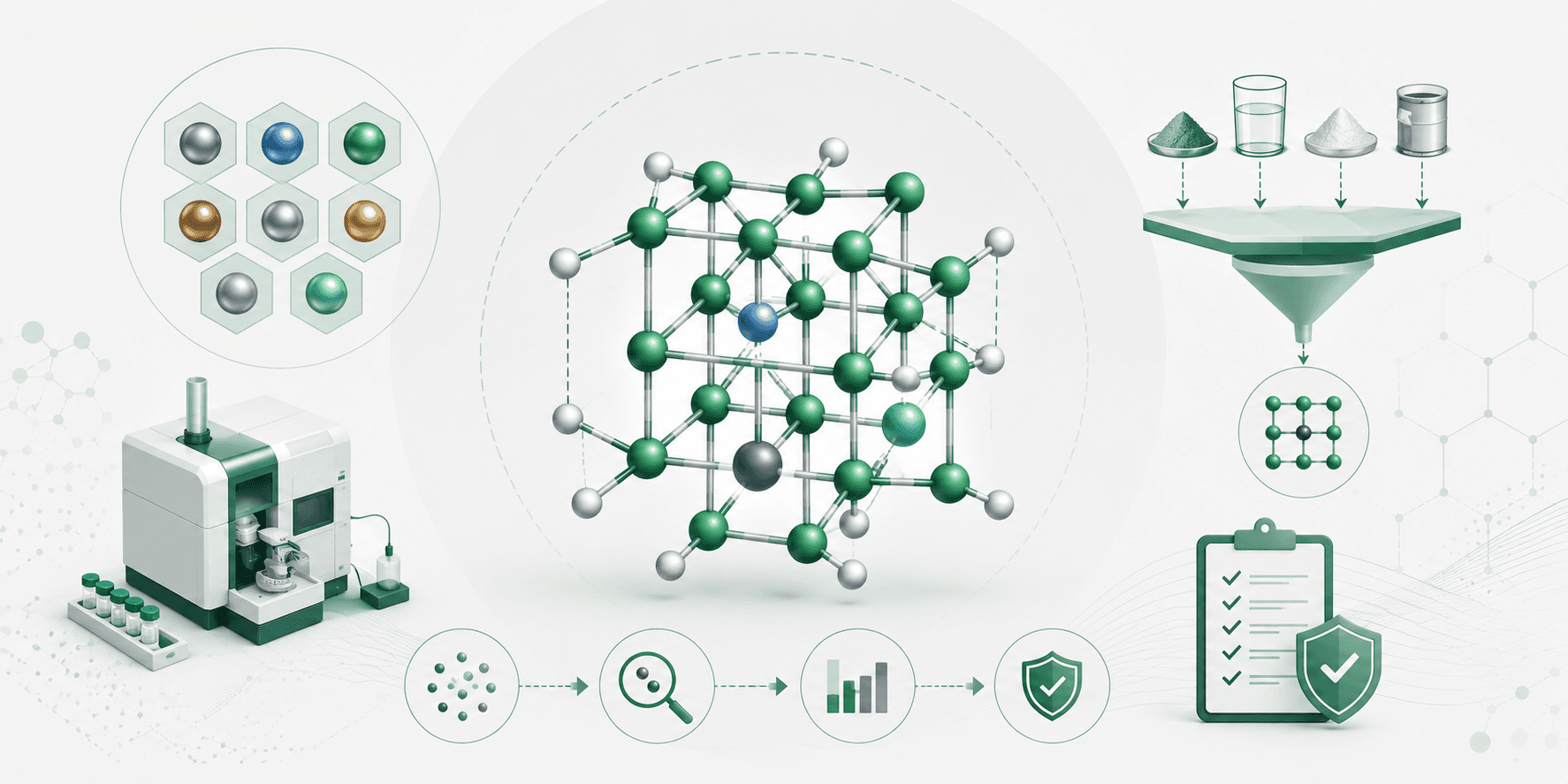
ICH Q3D replaced the older, largely testing-based approach to heavy metals — historically a broad, non-specific colorimetric limit test common across many pharmacopeias — with a risk-based framework built around a formal, documented elemental impurity risk assessment. This shift reflects two recognized limitations of the older approach: the traditional heavy metals test was neither sensitive nor specific enough to reliably detect several elements of genuine toxicological concern, and it did not distinguish between elements of meaningfully different toxicity, effectively treating a low-risk element and a high-risk one under the same blunt limit.
Under ICH Q3D, the assessment considers every potential source of elemental impurities in a drug product holistically — the drug substance itself, excipients, water, manufacturing equipment (including catalysts used in synthesis, and materials of construction for process equipment that could leach trace elements), and the container closure system — evaluating the probability that each source could contribute a given element at a level of genuine concern, rather than assuming routine testing of the finished product is required by default regardless of actual risk.
Risk Assessment Steps
A complete risk assessment typically proceeds through: identifying potentially relevant elements based on known use in the manufacturing process (most importantly, any catalysts or reagents deliberately containing a targeted element) and plausible environmental/incidental sources; evaluating the likely level of each element from each identified source, drawing on supplier data, process knowledge, or, where necessary, actual testing; and summing across sources to estimate total potential patient exposure, compared against the relevant PDE. This is explicitly a cumulative assessment across the whole product, not an isolated per-component check — an element present at a seemingly negligible level in several different components can still sum to a meaningful total exposure that a component-by-component review, considered separately, would miss.
Element Classification and Permitted Daily Exposures
The guideline classifies elements into groups based on toxicity and likelihood of occurrence in pharmaceutical materials, assigning each a Permitted Daily Exposure (PDE) that is further differentiated by route of administration — oral, parenteral, and inhalation routes each carry their own PDE for a given element, since the same element can present a very different actual risk depending on how the patient is exposed to it (parenteral and inhalation exposure generally bypass some of the body's normal absorption barriers, and PDEs for those routes are correspondingly often more stringent than the oral PDE for the same element).
Elements known to be used deliberately in synthesis — most commonly platinum-group metal catalysts used in certain synthetic transformations — generally warrant closer scrutiny in the risk assessment than elements with no plausible deliberate route into the product, since their presence is a known, documented process input rather than a speculative environmental contaminant. Where a catalyst is used, supplier and process data on residual catalyst levels in the isolated drug substance is typically the most direct and reliable evidence available for that specific risk source.
Testing Decision Tree
Where the risk assessment concludes that an element could reasonably be present above 30% of its PDE from any single source, or from the sum of sources, a control strategy is required — but importantly, this does not automatically mean routine testing. Consistent with the same underlying philosophy seen in ICH M7's approach to genotoxic impurities, control might instead mean tightening a raw material specification at its source, changing an equipment material of construction known to be a leaching risk, or another process-based control measure, rather than adding a new routine analytical test to every batch release specification.
Where the risk assessment concludes exposure is reliably and consistently below the 30% PDE threshold across all identified sources, routine testing is generally not considered necessary — the documented risk assessment itself, not a corresponding test result, serves as the ongoing basis for that conclusion, and should be periodically revisited if any of its underlying inputs (a raw material supplier, a piece of process equipment, a synthetic route) subsequently changes.
Supplier Data Use and Its Limitations
In practice, a significant part of building a defensible elemental impurity risk assessment involves gathering and critically evaluating supplier data — for example, catalyst use disclosures and residual metal data from an API manufacturer, or elemental composition certificates for excipients — rather than generating all the underlying data independently in-house, which would be both impractical and largely redundant with data the supplier likely already has. Where supplier data is incomplete, of uncertain analytical rigor, or simply unavailable, that gap itself becomes a documented part of the risk assessment, and depending on the element's inherent toxicity and the plausibility of its presence, may justify confirmatory testing even where the underlying calculated risk, based on incomplete data, appears low.
A common practical difficulty is that supplier elemental composition data, when available at all, is not always generated using methodology sensitive enough to confirm compliance against the relevant PDE-derived limit — a supplier's routine quality control testing for an entirely different purpose (such as a general purity specification) may use a method with a detection limit well above what the elemental impurity risk assessment actually requires to draw a confident conclusion, and this mismatch needs to be recognized and addressed rather than the supplier data being accepted uncritically at face value.
Ongoing Maintenance of the Risk Assessment
An elemental impurity risk assessment, once completed, is not a permanent, one-time document — it should be reassessed whenever a material input to the assessment changes: a new raw material or excipient supplier, a change in manufacturing equipment or its materials of construction, or a change to the synthetic route or catalyst system used for the drug substance. Because elemental impurity risk is fundamentally a function of the specific manufacturing inputs assessed, a risk assessment that is not actively maintained alongside these underlying changes can silently become outdated and no longer represent the product's actual current risk profile, undermining the very assurance it was originally created to provide.
Analytical Testing Where Testing Is Warranted
Where the risk assessment does conclude routine testing is needed, ICP-MS (inductively coupled plasma mass spectrometry) has become the generally preferred analytical technique, valued for its ability to simultaneously quantify many elements at the low parts-per-billion to parts-per-million sensitivity typically required by PDE-derived limits, in a single analytical run. ICP-OES (optical emission spectrometry) remains used for some applications, generally offering somewhat lower sensitivity than ICP-MS but adequate performance for elements with more permissive limits or higher expected concentrations.
Method validation for elemental impurity testing follows the same core ICH Q2(R2)-aligned parameters as any quantitative method, but with particular attention to sample preparation and digestion procedures — since many elemental impurity sources (a metal catalyst residue bound within an organic drug substance matrix, for example) are not necessarily present in a readily measurable, freely dissolved form, and inadequate sample digestion can produce a falsely low result that understates the material's true elemental content, giving misleading reassurance about actual patient exposure risk.
Special Considerations for Biologics and Complex Products
While ICH Q3D was developed primarily with small-molecule drug substances and excipients in mind, elemental impurity risk assessment principles extend to biologic and complex products as well, though the specific risk sources differ meaningfully — cell culture media components, purification resins, and single-use bioprocessing equipment each introduce their own distinct potential elemental impurity sources that a risk assessment for a small-molecule oral product would not need to consider. Facilities manufacturing both small-molecule and biologic products should recognize that a single generic elemental impurity risk assessment template developed for one modality is unlikely to adequately address the genuinely different risk sources relevant to the other.
Manufacturing Equipment as an Overlooked Source
Manufacturing equipment materials of construction — reactor linings, transfer piping, and any metal components in direct or repeated indirect contact with the product stream — deserve deliberate, specific attention in the risk assessment, since equipment-derived elemental contamination is easy to overlook relative to more obvious sources like a deliberately used catalyst. Stainless steel equipment, the industry-standard material of construction for much of pharmaceutical manufacturing, is itself an alloy containing chromium, nickel, and molybdenum among other elements, and while well-passivated stainless steel is generally a low-leaching, low-risk material under normal processing conditions, equipment corrosion, inadequate passivation, or unusually aggressive process chemistry (such as strongly acidic or chelating process streams) can meaningfully increase actual leaching risk beyond the generally low baseline assumption.
A thorough equipment-focused risk assessment considers not just the nominal material of construction, but also the equipment's age and maintenance history, the aggressiveness of the specific process chemistry it contacts, and, where genuine uncertainty exists, may be supported by targeted leachables testing of process intermediates or the final drug substance itself rather than relying solely on a generic assumption that "stainless steel equipment poses negligible elemental impurity risk" without product- and process-specific confirmation.
Building the Risk Assessment into New Product Development
For a genuinely new product, the most efficient point to conduct a thorough elemental impurity risk assessment is during formulation and process development itself, when material and equipment choices are still relatively flexible, rather than as a retrospective compliance exercise conducted only once a formulation and process are already largely finalized. Identifying a meaningful elemental impurity risk early — while an alternative excipient supplier, catalyst system, or equipment material of construction can still be reasonably substituted — is considerably less disruptive and costly than discovering the same risk after a process is locked in and validated, at which point addressing it may require a formal change control and possibly a partial revalidation exercise.
Leave your rating