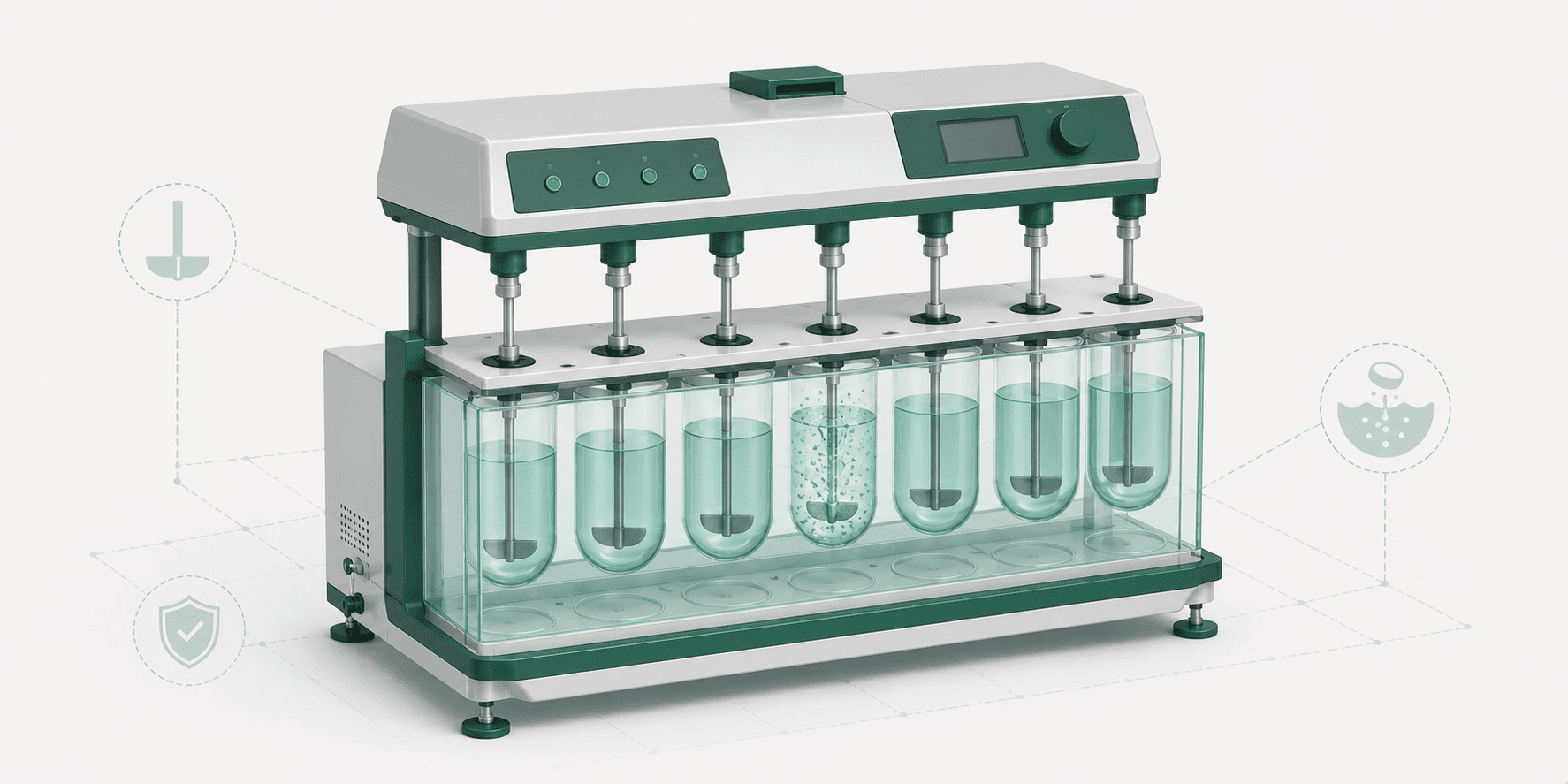
Why Dissolution Apparatus Qualification Is Especially Rigorous
Dissolution testing occupies a somewhat unique position among pharmaceutical analytical techniques: the test result is genuinely and demonstrably sensitive to small mechanical variations in the apparatus itself, such as vessel geometry, stirring element position, and rotational consistency, in a way that most other analytical measurements are not comparably sensitive to their supporting instrumentation.
This documented sensitivity is why dissolution apparatus qualification is typically conducted with a rigor, and a combination of both mechanical and performance-based verification, that exceeds what is applied to many other pieces of laboratory equipment used for less hydrodynamically sensitive test methods.
Mechanical Qualification
Dissolution apparatus qualification for USP Apparatus 1, the rotating basket, and Apparatus 2, the rotating paddle, begins with mechanical calibration, verifying parameters such as vessel internal dimensions and vessel centering relative to the stirring shaft, basket or paddle rotation speed accuracy across the apparatus's operating range, shaft wobble and vertical alignment, vessel temperature control accuracy and uniformity, and the precise vertical distance between the paddle or basket bottom and the vessel bottom.
These mechanical tolerances exist because dissolution results have been demonstrated, through published pharmaceutical science literature, to be genuinely sensitive to even small deviations in vessel geometry and stirring element position, which is not merely a procedural formality but reflects real, documented hydrodynamic sensitivity of the underlying test method itself.
Performance Verification Test
In addition to mechanical calibration, many quality systems incorporate a Performance Verification Test (PVT), running a standard reference tablet through the apparatus and comparing the resulting dissolution profile against an established, statistically defined acceptable range. USP has discontinued the Salicylic Acid Reference Standard tablet; the current official reference standard for this test is the Dissolution Performance Verification Standard (DPVS) – Prednisone Tablets. A specification or SOP still listing salicylic acid as an available calibrator, or citing an old lot, should be checked against USP's current PVT reference standard and procedure guideline before use.
A PVT provides a holistic, functional check that the apparatus as a complete assembled system produces results consistent with a known-behavior reference material, which can catch subtle interacting issues that individual mechanical measurements, each checked in isolation, might not reveal when the true problem arises from a combination of several small deviations acting together rather than any single parameter alone.
Common Failure Modes
Common sources of dissolution apparatus failure or marginal, borderline-acceptable results include vibration transmitted from nearby equipment or building infrastructure affecting the delicate hydrodynamics the test depends on, air bubbles adhering to the dosage form surface or vessel wall and disrupting normal dissolution behavior, incorrect vessel centering causing asymmetric, uneven flow patterns around the dosage form, and rotation speed drifting outside its qualified tolerance due to gradual motor bearing wear.
Because dissolution testing is inherently a hydrodynamically sensitive method, seemingly minor mechanical deviations, individually well within what might seem like a reasonable tolerance for other, less sensitive equipment types, can produce a disproportionately large effect on the observed dissolution result.
Frequency and Ongoing Monitoring
Dissolution apparatus qualification is typically performed on a defined periodic schedule, commonly at least annually, though facility-specific risk assessment may justify a different interval, combined with use-based and event-based triggers, such as following any maintenance affecting the vessel, shaft, or motor assembly, or following relocation of the equipment to a different laboratory space.
Between full qualification events, many laboratories perform simpler routine verification checks, such as periodic rotation speed spot-checks, as an intermediate monitoring layer, providing earlier warning of a developing mechanical issue than waiting for the next full scheduled qualification alone would provide.
Deaeration and Media Preparation Considerations
Because dissolved gases in the test medium can come out of solution as bubbles during a run, disrupting hydrodynamics at the dosage form surface, dissolution media preparation typically includes a deaeration step, and apparatus qualification programs sometimes include verification that the deaeration process itself is adequate and consistently applied, since inadequate deaeration is a well-recognized, frequently underappreciated source of variable dissolution results.
This consideration sits at the interface between equipment qualification and method execution, and a robust program addresses both — confirming the apparatus itself is mechanically sound, and confirming the media preparation procedure used with it consistently produces adequately deaerated medium before each test run.
Documentation and Trending
Qualification results, both mechanical calibration data and any PVT results, should be retained and actively trended over time, not simply filed as an isolated pass or fail record for each individual qualification cycle considered in isolation.
Trending allows a facility to detect a slow, gradual mechanical drift, for example gradually increasing shaft wobble approaching but not yet exceeding its tolerance limit, before it actually reaches the point of failing acceptance criteria outright, enabling proactive, planned maintenance rather than reactive troubleshooting undertaken only after a dissolution result has already come into question during routine testing.
Multi-Unit Comparability in Larger Laboratories
Laboratories operating multiple dissolution apparatus units, whether for throughput reasons or across multiple sites, should periodically confirm comparability between units using a common reference standard tablet, since two individually qualified units can still show subtly different performance characteristics that would not be apparent from each unit's own independent qualification record considered in isolation.
This comparability check is particularly relevant when a method developed and validated on one specific apparatus unit is subsequently intended for routine use across multiple units, since the method's validated performance was technically only ever demonstrated on the original unit unless comparability has been separately confirmed.
Sinker Use and Its Impact on Qualification
For dosage forms that float rather than sink naturally in the dissolution medium, sinkers, small wire devices used to hold the dosage form in a consistent position at the bottom of the vessel, are commonly used, and their use introduces an additional variable that qualification and method validation need to address explicitly. Different sinker designs can affect the dosage form's exposure to medium flow and, in some cases, its effective surface area, meaning a change in sinker type or design between method development and routine use is not necessarily a neutral, inconsequential change and should be evaluated for potential impact on dissolution results before being adopted.
Apparatus qualification programs should document which sinker type, if any, is used with which methods, and routine testing should confirm the correct, validated sinker type is actually being used for each specific method, since a well-intentioned but undocumented substitution of one sinker design for another, perhaps due to a supply shortage of the originally specified type, can introduce an unrecognized source of result variability.
Software and Data System Considerations
Modern dissolution apparatus is frequently paired with automated sampling and, increasingly, integrated UV or HPLC analysis systems controlled by dedicated software, and qualification of the complete system needs to address this software layer with the same rigor applied to the mechanical apparatus itself, including audit trail capability, user access control, and confirmation that automated sampling timing and volume are accurate and reproducible across the full run. Treating the mechanical apparatus and its control and data-handling software as entirely separate qualification concerns risks leaving a genuine data integrity or accuracy gap unaddressed, particularly for fully automated systems where an analyst has limited direct visibility into what the software is actually doing at each sampling time point during a run.
Vessel and Media Temperature Control Nuances
Temperature control accuracy should be verified at every vessel position during qualification, not at one representative vessel taken to stand in for the rest — a USP Apparatus 1/2 unit normally has six or eight vessels, and checking only one is a gap, not an acceptable shortcut, since vessel-to-vessel temperature variation within the same apparatus is a genuine, documented source of inter-vessel dissolution result variability that a single-vessel check would not detect. This is particularly relevant for water bath-style temperature control systems, where heating element placement and water circulation patterns can create measurable temperature differences between vessels positioned at different points around the bath, differences that would not be apparent unless each vessel position is individually verified during the qualification process.
Records Retention for Qualification Evidence
Given how frequently dissolution results feature in regulatory submissions and stability commitments, qualification records for the apparatus used to generate that data should be retained for at least as long as the underlying test data itself remains relevant, so that a question raised years later about a specific historical result can still be traced back to evidence the apparatus was in a qualified state at the time that result was generated, which is particularly important for products with long shelf lives where a stability commitment batch's dissolution data generated early in the product's life may still be actively referenced and relied upon in regulatory correspondence or an internal investigation occurring many years after the original testing was actually performed.
Leave your rating