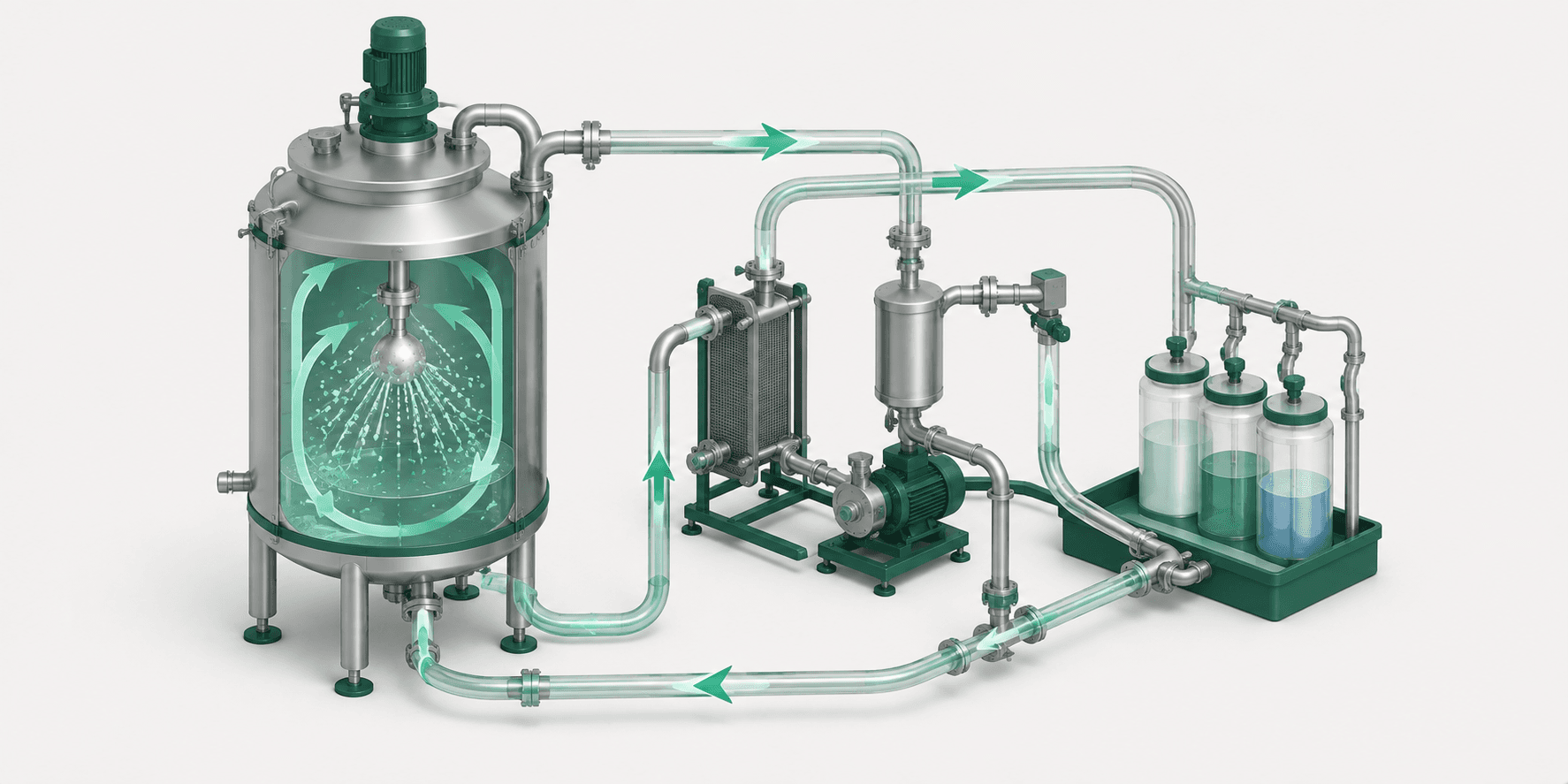
What CIP Systems Are and Why They Need Dedicated Validation
Clean-in-Place systems automate the cleaning of process equipment, reactors, tanks, and connected piping, without requiring the equipment to be disassembled, using a predefined, automated sequence of cleaning solutions and rinse cycles delivered through the equipment's own piping and spray devices.
Because CIP cleaning is automated and, once validated, generally runs unattended or with minimal direct operator intervention, its validation carries particular weight: unlike manual cleaning, where an operator's direct visual inspection and judgment provide an additional, real-time layer of assurance during the cleaning process itself, CIP relies entirely on the validated cycle parameters being executed correctly and consistently, batch after batch, without that same direct human oversight during execution.
Validation Scope
Validating a CIP system confirms that the automated cleaning cycle, typically a defined sequence of pre-rinse, detergent wash, intermediate rinse, and final rinse steps, each with specifically controlled time, temperature, flow rate, and detergent concentration parameters, reliably removes both product residue and cleaning agent residue from the equipment's product-contact surfaces to an acceptable, validated level, consistently and reproducibly across multiple executions.
A single favorable validation run is not sufficient evidence of this consistency, which is why CIP validation protocols typically require multiple successful executions of the exact same cycle before the cycle is considered genuinely validated for routine use.
Worst-Case Selection
Because a CIP system typically cleans multiple different products or product families through the same shared equipment, validation is usually built around a documented worst-case selection approach, identifying the specific product or combination of products judged hardest to clean based on factors like solubility, potency or toxicity relative to the next product's dose, and any known tendency to adhere strongly to equipment surfaces, along with the equipment configuration hardest to reach effectively.
Validating only against an easy-to-clean product and a straightforward equipment configuration would not provide meaningful assurance for genuinely harder-to-clean products and configurations sharing the same equipment train, which is why the worst-case rationale itself needs to be explicitly documented and periodically reassessed as the facility's product portfolio changes over time.
Sampling and Analysis
Post-cleaning verification typically combines swab sampling of directly accessible surfaces with rinse sampling to represent areas the CIP system cleans but that are not directly accessible for physical swabbing, such as internal piping runs, analyzed for both residual active pharmaceutical ingredient and, separately, residual cleaning agent.
Visual inspection is commonly included as a routine supplementary check but is generally treated as complementary to, not a substitute for, analytical verification, since a visually clean surface can still carry meaningful residue below the threshold of visual detection by even a well-trained inspector working under good lighting conditions.
Spray Coverage and Pattern Verification
A validation element specific to CIP, distinct from cleaning validation for manual methods, is confirming the automated spray devices actually achieve adequate, complete coverage of every internal surface intended to be cleaned by the system, a riboflavin coverage test, using a UV-fluorescent tracer coating applied to internal surfaces before running the CIP cycle and then inspecting under UV light afterward for any areas the spray pattern failed to adequately reach, is a commonly used technique specifically for this purpose.
Coverage verification and chemical residue sampling address related but genuinely distinct failure modes, and a validation program relying on chemical residue data alone, without ever confirming physical spray coverage, risks missing a spray pattern gap that happens not to coincide with the specific locations chosen for chemical sampling.
Acceptance Criteria
Acceptance criteria are derived using the same underlying health-based, calculation-driven logic as manual cleaning validation, a calculated maximum allowable carryover based on the next product's dose and the shared equipment's total surface area, translated into a specific swab or rinse concentration limit appropriate to the sampling method actually used.
Maintaining the Validated State
Once validated, the CIP cycle's specific parameters, time, temperature, detergent concentration and type, and flow rate at each stage, effectively become the fixed, defined process the equipment must execute to remain in its validated state going forward.
Changing any of these parameters, or introducing a new product to the shared equipment train not covered by the original worst-case selection rationale, without appropriate revalidation risks invalidating the original cleaning validation's underlying data and conclusions, even where the change might intuitively seem minor or unrelated to actual cleaning effectiveness.
CIP Skid Design and Piping Considerations
The design of the CIP skid itself, the mobile or fixed unit that generates and delivers the cleaning solutions, and the piping network connecting it to the equipment being cleaned, materially affects cleaning effectiveness in ways that are easy to overlook if validation attention focuses solely on the cleaning cycle's time and temperature parameters, since inadequate flow velocity through connected piping, or dead-leg sections of piping with poor flow exchange, can leave localized areas inadequately cleaned even when the overall cycle parameters appear entirely satisfactory at the skid's own control point.
Facility engineering standards increasingly specify maximum acceptable dead-leg length relative to pipe diameter specifically to manage this risk, and CIP validation should confirm the as-built piping configuration for each piece of equipment actually meets these design standards, since a piping modification made after initial CIP validation, for example extending a branch line to accommodate new equipment, can inadvertently introduce a dead-leg condition the original validation never evaluated.
Automation and Recipe Management
Modern CIP systems are typically controlled through a recipe-based automation system, where each validated cleaning cycle is stored as a specific, named recipe the operator selects rather than manually entering parameters for each run, and this recipe management layer deserves its own qualification attention, confirming the system reliably executes the exact validated parameters associated with a selected recipe and that recipe selection and modification are subject to appropriate access control consistent with the facility's broader computer system validation and data integrity expectations.
An unauthorized or accidental recipe modification, if not adequately controlled, could silently alter a previously validated cleaning cycle's actual parameters without triggering any obvious alarm, which is why recipe change control and audit trail review are considered an integral part of a mature CIP validation and ongoing monitoring program, not a separate, lower-priority IT concern disconnected from the cleaning validation itself.
Relationship Between CIP Validation and Broader Equipment Qualification
Because a CIP skid is itself a piece of process equipment with its own pumps, valves, heating elements, and control system, it requires its own equipment qualification lifecycle, installation, operational, and performance qualification, addressing whether the skid itself can reliably deliver the flows, temperatures, and concentrations the validated cleaning cycles depend on, entirely separate from and prior to the cleaning validation exercise that then confirms those delivered conditions actually achieve adequate cleaning of the connected process equipment, and facilities sometimes conflate these two distinct qualification efforts in ways that leave a genuine gap, for example assuming that because the CIP skid itself was qualified as reliably delivering its programmed setpoints, the cleaning cycles built on top of that skid must therefore also be validated, when in fact cleaning validation requires its own separate, dedicated demonstration using the specific residue sampling and worst-case selection methodology described throughout this article.
A clear, well-documented qualification and validation master plan for a facility's CIP infrastructure should explicitly distinguish these two layers, equipment-level qualification of the CIP skid and delivery system itself, and product-and-process-level cleaning validation of specific cycles applied to specific pieces of connected process equipment, so that project planning, resourcing, and eventual regulatory inspection readiness all correctly reflect that both layers of evidence are genuinely required and neither can substitute for the other. Facilities that discover this gap only during an actual regulatory inspection, when an inspector specifically asks to see cleaning validation data distinct from the CIP skid's own equipment qualification records, are placed in a considerably more difficult position than those that structured their documentation to make this distinction clear from the outset of the original qualification and validation program, often needing to reconstruct a defensible justification for the adequacy of their cleaning practices under real time pressure during the inspection itself, rather than simply presenting documentation that had already been organized and readily available well in advance of any such regulatory scrutiny arising.
Leave your rating