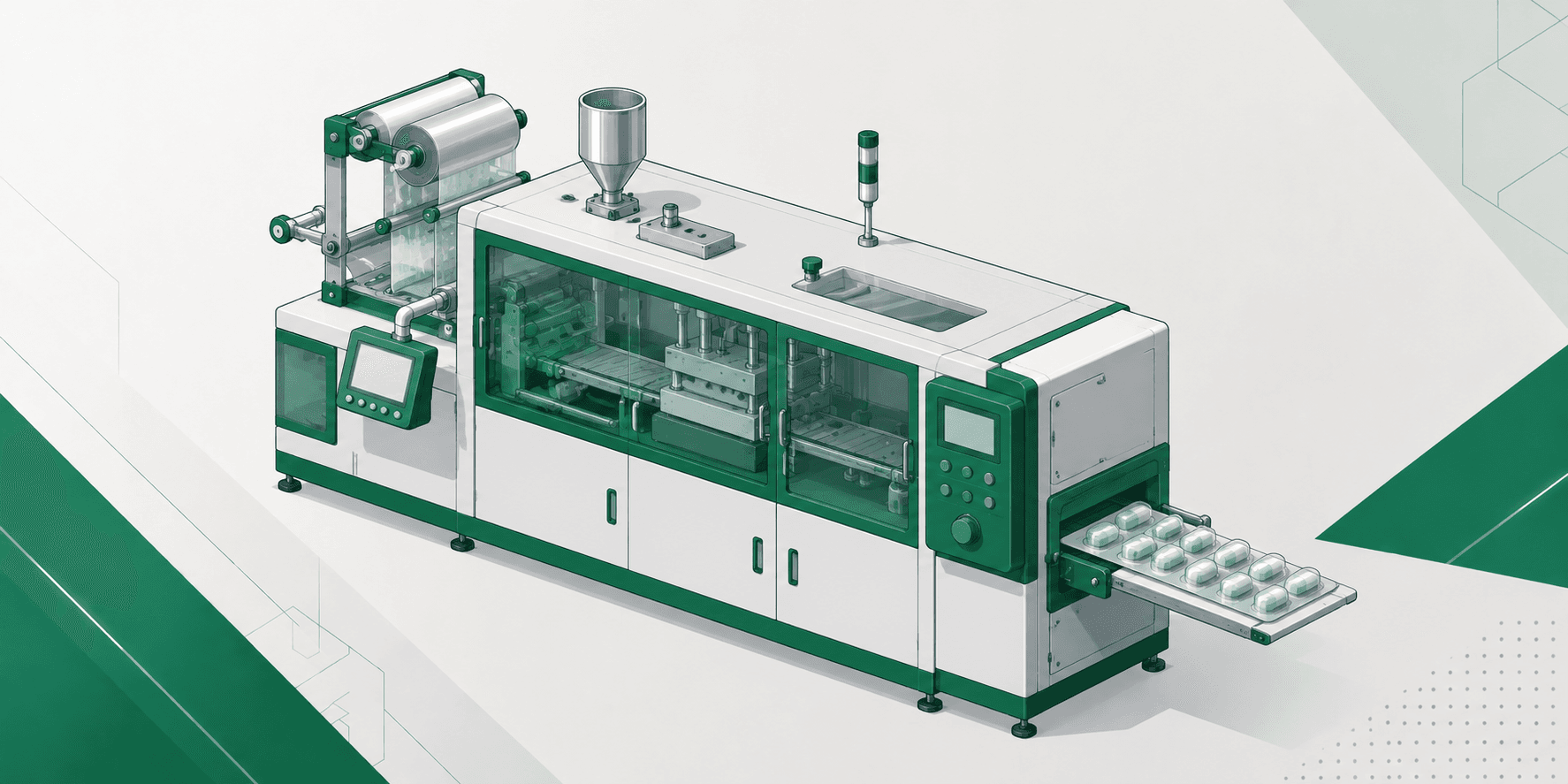
The Distinct Challenge of a Multi-Product Packaging Line
A URS for a blister packaging line differs in an important structural respect from a URS for a single-purpose laboratory instrument: a packaging line is very rarely dedicated to a single product for its operational life, and the specification needs to explicitly account for the genuine range of products, formats, and changeover scenarios the line will actually encounter over its commercial lifetime, not simply the specific product or two that happen to be driving the immediate purchase decision.
This multi-product reality should shape the URS from its earliest drafting stage, since a specification written narrowly around a single current product tends to under-specify the flexibility a real commercial packaging operation actually needs, leaving the facility with a technically compliant but operationally limiting piece of equipment once a second or third product needs to run on the same line.
Throughput and Format Range
A URS for a blister packaging line should specify required throughput, units, blisters, or cartons per minute or per shift, at the intended operating scale, along with the full range of blister formats, pack sizes, and product types the line needs to handle, including any known future products already in the development pipeline, not solely the current commercial portfolio.
Format flexibility is far cheaper and simpler to specify correctly upfront than to retrofit onto already-purchased, already-installed equipment later, and the URS should explicitly include both the forming film and foil materials anticipated for use and the range of tablet or capsule sizes and shapes the machine must reliably accommodate across its expected product range.
Format Change Requirements
Because most blister lines run multiple products in sequence, changeover time and complexity are often as commercially and operationally important as raw maximum throughput. The URS should specify expected changeover frequency, a target changeover time, and whether tooling changes, forming dies, sealing plates, cutting stations, need to be quick-change or effectively tool-less, or whether more time-consuming mechanical adjustment involving specialized tooling and setup time is acceptable given the facility's actual production scheduling patterns.
Where changeover speed is genuinely commercially important, this should be reflected not just as a general preference but as a specific, testable requirement with a numeric target, since vendors can otherwise interpret a vague "fast changeover" expectation quite differently from what the facility actually needs in practice.
Integration and Data Needs
Modern packaging lines are rarely standalone islands of automation, and the URS should specify integration requirements with upstream and downstream equipment, most importantly cartoning equipment and serialization or track-and-trace printing and vision inspection systems, along with any data connectivity needed for batch record data capture, overall equipment effectiveness monitoring, or integration with a manufacturing execution system.
Retrofitting serialization capability or broader data-connectivity requirements onto equipment not originally specified with them in mind is a common, and often genuinely expensive, gap when these needs are left out of the original URS and only discovered as a requirement later, once the equipment is already committed to a purchase order.
Materials Handling and Waste Considerations
The URS should also address practical materials handling aspects often overlooked in an initial functional-requirements-focused draft, including film and foil roll change frequency and the operator effort involved, waste and reject handling, how rejected units identified by inline vision inspection are physically diverted and accounted for, and, where relevant, any requirements around printed or coded material traceability during the roll change process itself.
Reject handling in particular matters both for line efficiency and for reconciliation accuracy in the batch record, since a packaging line generating an unaccounted-for discrepancy between input and output quantities creates a genuine batch record reconciliation problem that good reject-tracking design specifically prevents.
Validation and Documentation Requirements
Beyond the equipment's own functional and technical capability, the URS should specify the vendor documentation package expected to support the receiving facility's own qualification effort, including factory acceptance testing protocols and results, standard operating and maintenance documentation, and, where the line includes its own computerized control or vision inspection system, appropriate computer system validation documentation consistent with the facility's own CSV approach.
A vendor unable or unwilling to supply an adequate documentation package represents a genuine, quantifiable qualification burden shifted onto the receiving facility, and this should be weighed explicitly as part of vendor evaluation, not discovered only after the purchase decision has already been made and the equipment is already on order.
Acceptance Testing
The URS should define how the equipment will ultimately be accepted, typically a Factory Acceptance Test at the vendor's facility before shipment, confirming basic functional performance before the equipment and the cost of shipping it are committed, followed by a Site Acceptance Test after installation at the receiving facility, each with defined test cases explicitly traceable back to the functional and technical requirements stated earlier in the URS document.
Defining acceptance test criteria within the URS itself, rather than leaving them to be negotiated informally later in the purchase process, keeps the vendor accountable to the requirements the original purchase decision was actually based on, rather than to a looser, potentially renegotiated standard agreed under time pressure closer to delivery.
Vendor and Long-Term Support Considerations
Because a blister packaging line is typically a significant, long-lived capital investment expected to remain in service for many years, the URS should also capture expectations around ongoing vendor support, spare parts availability over the equipment's expected service life, and the vendor's track record supporting similar equipment already installed at comparable pharmaceutical facilities.
A line purchased primarily on price without adequately weighing these longer-term support factors can end up costing considerably more over its service life through extended downtime during parts sourcing delays or unsupported software, which is why vendor evaluation criteria in the URS should give genuine, documented weight to these factors alongside initial purchase price.
Environmental and Utility Requirements
Blister packaging equipment generates heat during the film-forming and sealing process, and depending on the specific technology used, may also require compressed air, cooling water, or vacuum utilities, each of which needs to be specified in the URS with actual quantities and quality requirements rather than left for the vendor to assume based on a typical, generic installation that may not match the receiving facility's actual utility infrastructure and its existing capacity limits.
Room environmental conditions, including temperature and humidity, can also affect blister forming quality for certain film materials, particularly PVC-based films that are somewhat sensitive to ambient humidity during the forming process, and where the facility's packaging room does not already maintain tight environmental control, the URS should specify whether the new equipment needs to include its own local environmental conditioning or whether the receiving facility will separately upgrade room-level environmental control to support reliable forming quality across seasonal variation.
Operator Ergonomics and Safety Design
Beyond core functional and technical requirements, a thorough URS addresses operator ergonomics and safety design considerations specific to a packaging line's actual daily operation, including reasonable reach heights for routine tasks such as film roll loading, clear and unambiguous machine status indication so operators can quickly recognize a fault condition requiring intervention, and noise levels consistent with the facility's occupational health requirements for sustained operator presence near the running equipment.
These ergonomic and safety considerations are sometimes treated as secondary to core throughput and format requirements during URS drafting, but a poorly ergonomic design can measurably affect real operator changeover speed and error rate in routine use, meaning ergonomics is not purely a worker-welfare consideration but has genuine, measurable operational performance implications worth capturing explicitly in the specification, and facilities that involve actual line operators in reviewing a draft URS or evaluating a vendor's proposed machine layout before final purchase commitment often catch ergonomic and workflow issues that a specification written purely by engineering or procurement staff, without direct hands-on packaging line experience, would not have anticipated until the equipment was already installed and operators began raising the same issues during routine daily use. This kind of operator-informed review is a low-cost step relative to the total capital investment a packaging line represents, and the modest time it adds to the procurement timeline is generally well justified by the reduced likelihood of discovering a significant, expensive-to-retrofit design shortcoming only after the equipment has already been delivered, installed, and put into routine commercial operation.
Leave your rating