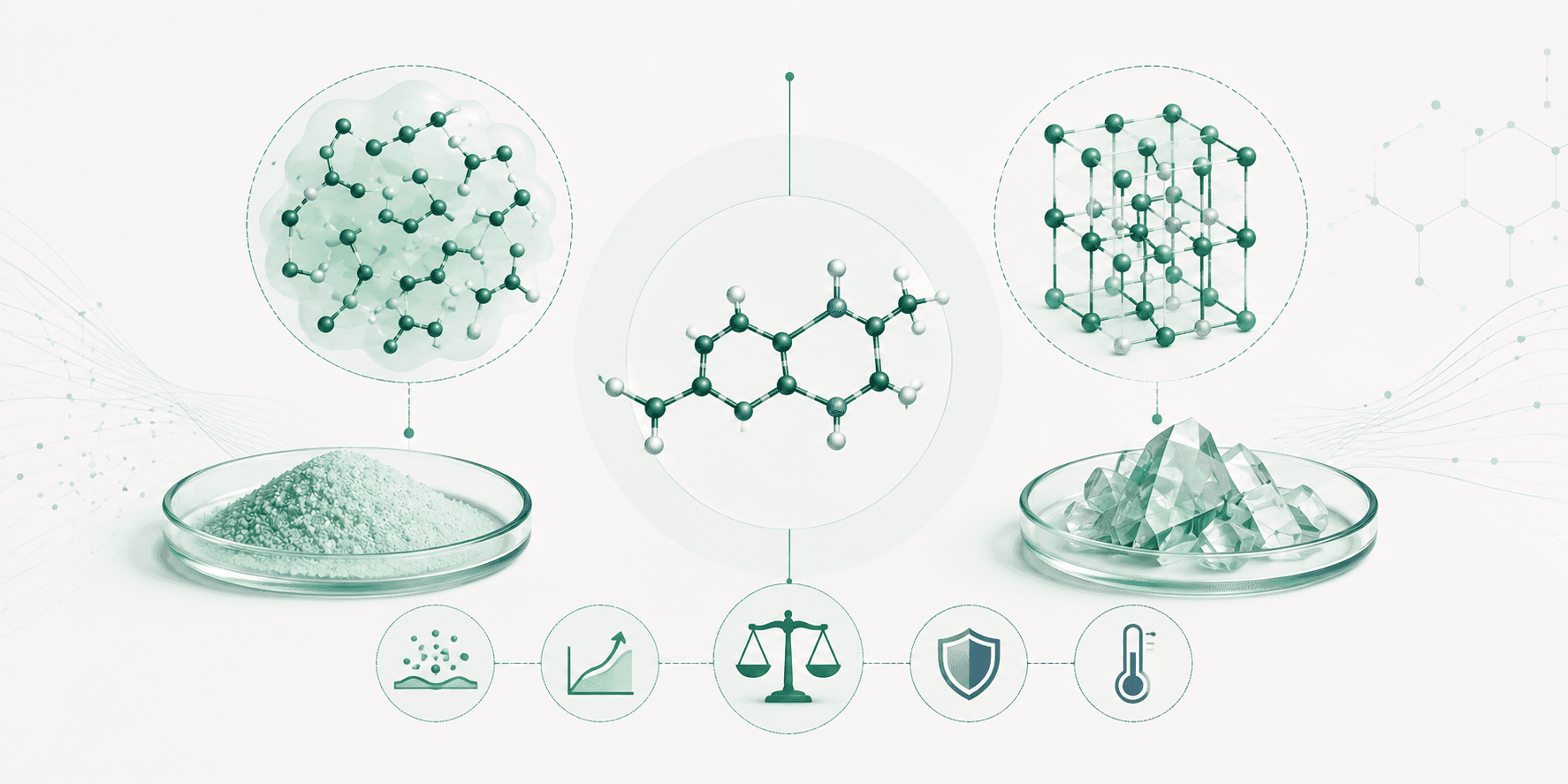
Two Fundamentally Different Solid States
A crystalline solid has molecules arranged in a repeating, ordered three-dimensional lattice, representing a well-defined, thermodynamically stable (or, for a metastable polymorph, at least locally stable) energy minimum. An amorphous solid, by contrast, lacks this long-range order entirely — its molecules are arranged more like a frozen liquid, in a disordered, higher-energy state. This fundamental structural difference is the root cause of essentially every practical difference in behavior between the two forms that a formulator needs to manage, from solubility through mechanical properties to long-term stability.
Understanding which state a given development candidate is in — and, more importantly, whether the compound is even capable of forming a stable, isolable amorphous solid at all, since not every molecule readily does — is one of the earliest and most consequential preformulation characterization questions (see the related preformulation studies article), because it shapes the entire subsequent formulation development strategy for a poorly soluble compound.
Solubility and Bioavailability
Because the crystalline lattice represents a lower-energy, more thermodynamically stable state, disrupting that lattice — as in an amorphous form — generally increases apparent solubility and dissolution rate, often substantially, for poorly soluble compounds. This occurs because dissolving an amorphous solid does not require breaking the same strong, ordered lattice energy that a crystalline solid's molecules are held together by; the energy cost of dissolution is correspondingly lower, and the observed solubility (strictly, the apparent or "spring" solubility, since amorphous solubility is a metastable, time-limited phenomenon rather than a true equilibrium value) is higher.
This is the primary reason amorphous forms are deliberately pursued in formulation development for BCS Class II and IV compounds (in the Biopharmaceutics Classification System framework), where dissolution rate or solubility, rather than intestinal permeability, is the rate-limiting step for oral absorption. For such compounds, achieving and maintaining an amorphous or near-amorphous state within the finished formulation can be the difference between a therapeutically viable oral product and one whose bioavailability is too low and too variable to be clinically useful.
Physical Stability Risk
The same lack of lattice order that gives an amorphous form its solubility advantage also makes it thermodynamically unstable relative to the crystalline form — it exists in a higher energy state and has a natural, spontaneous tendency to relax back toward crystallinity over time, particularly under elevated temperature (which increases molecular mobility) or humidity (where absorbed moisture can plasticize the amorphous matrix, lowering its glass transition temperature and dramatically accelerating recrystallization kinetics). This recrystallization, if it happens during the product's shelf life, can silently erode the solubility advantage the formulation was originally designed around, without necessarily being obvious from a simple visual inspection of the dosage form.
Because of this risk, physical stability monitoring is treated as a first-class stability attribute for amorphous formulations — on par with, and arguably more consequential than, chemical (potency/degradation) stability testing for these specific products — rather than an afterthought layered on top of standard chemical stability protocols. Analytical techniques such as X-ray powder diffraction (sensitive to the emergence of crystalline peaks against an otherwise amorphous halo) and differential scanning calorimetry are commonly used throughout stability studies specifically to detect early, low-level recrystallization well before it would become apparent through a dissolution or potency test alone.
Manufacturing Implications
Amorphous forms are rarely used as-is; they are typically stabilized within a formulation matrix — most commonly as an amorphous solid dispersion with a polymer carrier (see the related solid dispersion techniques article) — because the pure amorphous API alone is usually too physically unstable, on its own, to have a commercially viable shelf life outside of a stabilizing matrix. This adds real manufacturing complexity compared with conventional crystalline-API tableting or encapsulation: processes such as hot-melt extrusion or spray-drying are needed to actually create the amorphous solid dispersion, each carrying its own process parameters, equipment investment, and characterization burden.
This added complexity typically requires more extensive and more sensitive process characterization and in-process control to ensure the amorphous state is both genuinely achieved during manufacturing and then maintained all the way through into the finished, packaged product — a materially higher development and validation burden than a straightforward crystalline-API formulation would require, and one that should be factored into program timelines and resourcing decisions from the outset rather than discovered midstream.
Decision Framework
The decision between amorphous and crystalline formulation approaches is generally driven by whether the crystalline form's solubility is genuinely limiting bioavailability enough — demonstrated through actual solubility and, ideally, early pharmacokinetic data — to justify the added development complexity, manufacturing cost, and ongoing stability-management burden of an amorphous strategy. For compounds with adequate crystalline-form solubility relative to their required dose and permeability, the added stability risk and process complexity of an amorphous approach are rarely justified purely on theoretical grounds.
For genuinely poorly soluble compounds where crystalline-form bioavailability is unacceptably low or shows high inter-subject variability in early studies, the solubility benefit of an amorphous approach can outweigh the added stability-management burden — but this decision should be made deliberately, grounded in actual comparative data between crystalline and amorphous prototype performance, rather than defaulting to an amorphous strategy simply because a compound is qualitatively described as "poorly soluble" without a clearer, quantitative assessment of whether that solubility limitation is actually the dominant barrier to adequate absorption.
Alternative Bioavailability Enhancement Strategies
Amorphous solid dispersion is one of several available approaches to addressing solubility-limited bioavailability, and a thorough formulation strategy assessment typically weighs it against alternatives such as particle size reduction (micronization or nanomilling, which increases surface area without changing the underlying crystalline state, generally carrying lower physical-stability risk but also a more modest solubility benefit than a true amorphous transformation), lipid-based formulation approaches, and cyclodextrin complexation. Each alternative carries its own distinct trade-off profile between achievable solubility enhancement, physical stability risk, manufacturing complexity, and cost.
Selecting among these approaches benefits from a structured, data-driven screening exercise early in development — testing a small set of prototype approaches against the specific compound's actual solubility and permeability characteristics — rather than defaulting to whichever technology a given development team or contract manufacturing partner happens to have the most in-house experience with, since the compound's specific physicochemical profile, not organizational familiarity, should be the primary driver of this technically consequential formulation decision.
Monitoring Amorphous Content Through the Product Lifecycle
For a product ultimately built on an amorphous or partially amorphous formulation strategy, ongoing monitoring of amorphous content — not just conventional chemical assay and degradation product testing — is an important part of the routine stability and, in some cases, batch release testing program, since a batch could pass every conventional chemical specification while having already undergone meaningful recrystallization that would compromise its actual in-vivo performance. Quantitative XRPD methods capable of measuring the percentage of crystalline content against an amorphous background are commonly developed and validated specifically for this ongoing monitoring purpose, distinct from the qualitative form-identification XRPD methods used earlier in development.
Manufacturing Process Impact on the Amorphous State
The manufacturing processes used to create and then process an amorphous solid dispersion into a finished dosage form each carry their own risk of inadvertently disturbing the intended amorphous state. Downstream unit operations applied after the dispersion itself is created — milling, blending, tableting compression force, and film coating (which typically involves aqueous or solvent exposure and elevated temperature) — can each, in principle, provide sufficient mechanical or thermal energy, or introduce sufficient localized moisture, to trigger localized recrystallization even in a dispersion that was confirmed fully amorphous immediately after its initial manufacture.
Because of this, process characterization for an amorphous solid dispersion product ideally includes solid-state confirmation testing at multiple points through the full manufacturing process — not solely on the initial dispersion intermediate and the final finished product — so that if a downstream processing step is found to introduce a meaningful crystallinity risk, that specific step can be identified and addressed (through parameter adjustment, or formulation modification) rather than only being detected as an unexplained quality issue in the finished product with the actual root cause left unclear.
Comparative Cost and Timeline Considerations
Beyond the technical considerations already discussed, an amorphous solid dispersion strategy carries real practical development cost and timeline implications that should be weighed as part of the overall formulation strategy decision — specialized equipment (hot-melt extruders or spray dryers capable of pharmaceutical-grade, GMP production), additional analytical method development specifically for solid-state characterization, and typically a longer overall formulation development timeline given the additional characterization and stability confirmation work required. These practical program-level costs are a legitimate part of the decision alongside the underlying pharmaceutical science, and a development team should weigh them transparently against the genuine bioavailability benefit the approach is expected to deliver, rather than treating the formulation science alone as the sole basis for the strategic decision.
Regulatory Filing Considerations for Amorphous Products
A regulatory submission built around an amorphous formulation strategy generally needs to present a more extensive solid-state characterization and control package than an equivalent crystalline-form submission would require — including the analytical methods used to confirm and monitor amorphous content, the stability data demonstrating the amorphous state is maintained through the proposed shelf life under the proposed storage conditions, and a clear control strategy for detecting and responding to any physical instability observed during ongoing commercial production and stability monitoring. Reviewers evaluating such a submission will typically expect to see evidence the applicant has genuinely characterized the risk of recrystallization specific to their formulation, not simply asserted the amorphous form's general theoretical solubility advantage without addressing its corresponding, well-documented physical stability risk.
Leave your rating